Sunday, March 31, 2019

Accumulate Dabur India; target of Rs 491: Arihant Capital


Arihant Capital's research report on Dabur India


Dabur India Ltd. (Dabur) is the fourth largest FMCG Company of the country presently catering to health care, personal care & food segment. The company is expected to report 10.9% CAGR growth in revenue over FY18-21E while PAT will witness a CAGR of 12.5% over the same period.


Outlook


We are positive on the future prospects of Dabur and initiate coverage with an "Accumulate" rating on the stock with a target price of Rs 491, which gives an upside potential of 16.9%.


For all recommendations report, click here


Disclaimer: The views and investment tips expressed by investment experts/broking houses/rating agencies on moneycontrol.com are their own, and not that of the website or its management. Moneycontrol.com advises users to check with certified experts before taking any investment decisions.

Read More First Published on Mar 26, 2019 04:00 pm

Thursday, March 28, 2019

Buy KSB Pumps; target of Rs 795: ICICI Direct


ICICI Direct's research report on KSB Pumps


Total operating income in Q4CY18 came in at Rs 346.6 crore, up 5.6% YoY. In terms of segmental break-up, the pumps division reported sales at Rs 287 crore, up 3.8% YoY while the valves division reported sales at Rs 60 crore, up 15.4% YoY EBITDA margins in Q4CY18 came in healthy at 13.8% in Q4CY18. The corresponding EBITDA was at Rs 47.9 crore. The EBIT margin for the valves segment improved to 10.5% (10.4% in Q4CY17). PAT in Q4CY18 came in at Rs 25.3 crore, down 7.5% YoY. Associate company i.e. MIL Control Valves reported lower PAT share for CY18 at Rs 4.3 crore, down 17.3% YoY.


Outlook


It has a debt free balance sheet with surplus cash of ~Rs 140 crore. Over CY18-20E, we expect KSB to clock sales, EBITDA & PAT CAGR of 9.0%, 11.6% & 17.6%, respectively. Core RoICs are also expected to improve to 16.2% by CY20E vs. 14.7% in CY18. We value KSB at Rs 795 i.e. 28x P/E on CY20E EPS of Rs 28.4. We maintain our BUY rating on the stock.


For all recommendations report, click here


Disclaimer: The views and investment tips expressed by investment experts/broking houses/rating agencies on moneycontrol.com are their own, and not that of the website or its management. Moneycontrol.com advises users to check with certified experts before taking any investment decisions.

Read More First Published on Mar 22, 2019 03:06 pm

Saturday, March 23, 2019

CVS CEO: Changing the retail and stabilizing the long-term care businesses

CVS Health CEO Larry Merlo told CNBC Thursday that the health chain is unlocking growth opportunities despite the stock's downward trend since officially merging with Aetna in November.

The company has made "tactical execution" changes to its long-term care business that has faced "intense financial pressure," he said. The skilled nursing unit came from CVS' 2015 acquisition of Omnicare.

"The real growth opportunity in that space is in the assisted and the independent living space," Merlo said in an interview with "Mad Money's" Jim Cramer. "We feel that we've got the business stabilized and it'll grow from this point forward."

Shares of CVS are down about 30 percent from its November high of about $82 that preceded the $69 billion closing of the Aetna deal. In defending the acquisition, Merlo said critics who thought CVS should have bought back stock instead are "limited in their thinking." The retailer and managed health care can achieve more combined than as separate entities, he said.

"As we think about this new company, we're gonna manage it at an enterprise level," he said.

The health care industry has reached $3.5 trillion and is "growing at an unsustainable rate," said Merlo, who pointed out that an estimated quarter of health care spending is wasteful and reducible. With lessons from the Caremark merger last decade in in the rearview mirror, CVS is focused on reducing medical costs, he added.

"Percentage points are going to matter here," he said. "Being able to reduce those unnecessary costs, you know, the value created is going to start with a 'b' as in billion. That's the opportunity that's in front of us."

CVS' retail has found growth in both the front store and pharmacy, Merlo said. The pharmacy chain dropped tobacco products from its shelves in 2014, but is looking to add more cannabis-based oils in its stores as interest grows. Locations in eight states carry non-CVS branded CBD products and have helped to ease arthritic pain, Merlo said.

Cannabidiol is a natural compound found in cannabis.

"We're gonna walk slowly, but we think that this is something that customers are going to be looking for and it's, you know, part of the health offering," he said.

Merlo also highlighted early results in new HealthHUBs concept stores being piloted in the Houston, Texas area. The revamped stores are tailored for clinical services including treating acute illnesses and managing chronic diseases. Dietitians and respiratory therapists are on staff, Merlo said.

Other services include wellness programs and in-store sessions geared towards the community, which allows them to learn what's important to customers, he said. CVS wants to help people access care that's convenient for them whether it's in the community, at home or on a smartphone, he said.

"You think about the imperatives that this new company can create, the opportunity to make health care local, the opportunity to make it simple and the opportunity to improve health," Merlo said. "The concept stores begin to execute against that imperative."

WATCH: Cramer sits down with CVS CEO Larry Merlo show chapters CVS CEO Larry Merlo: We are working to reduce medical costs to unlock billions in value CVS CEO Larry Merlo: We are working to reduce medical costs to unlock billions in value    3 Hours Ago | 11:34

Disclaimer: Cramer's charitable trust owns shares of CVS.

Questions for Cramer?
Call Cramer: 1-800-743-CNBC

Want to take a deep dive into Cramer's world? Hit him up!
Mad Money Twitter - Jim Cramer Twitter - Facebook - Instagram

Questions, comments, suggestions for the "Mad Money" website? madcap@cnbc.com

Tuesday, March 19, 2019

Reality Will Eventually Hit World Wrestling Entertainment Stock

World Wrestling Entertainment (NYSE:WWE) stock highlights the very real importance of not letting your biases impact your judgment. I learned that the hard way. Last year, I wrote a disparaging article about WWE stock.

WWE Stock May Be Overbought, But Don't Bet Against ItWWE Stock May Be Overbought, But Don't Bet Against ItSource: Shutterstock

Later, I followed that up with a muted, but nevertheless bearish, assessment. Both columns turned out to be wrong.

In my defense, I think most (reasonable) people would cut me some slack. We’re talking about scripted events during which grown men – and sometimes women – prance around like idiots, engaging in fake conflicts. Combatants exchange words, and fists start flying. Invariably, out of the blue someone comes running out with a chair.

This is either a scene from Facebook’s (NASDAQ:FB) boardroom discussions or the catalyst for the inexplicable rise of WWE stock price. At least if someone had secretly recorded an executive-level meltdown at the social-media firm, I would understand why watching it would be a guilty pleasure.

WWE? Forgive me, folks, but I just don’t get it.

But I made the same mistake when I initially analyzed WWE stock. Sure, I had hard facts to back me up, such as declining TV viewership. Also, sports-related stocks, such as Manchester United (NYSE:MANU), haven’t historically performed well.


Compare Brokers

Unfortunately, I didn’t appreciate that the people who care about pro-wrestling tend to be extremely fanatical. Of course, executives at Twenty-First Century Fox (NASDAQ:FOXA) had a much more open mind than I did. They inked a deal to broadcast SmackDown Live on the Fox network , launching the WWE stock price to the moon.

WWE stock price dropped during the market meltdown at the end of last year, but the shares recovered in 2019 with the rest of the market, and WWE stock price is up nearly 24% in 2019.

The WWE Stock Price Will Meet a Flying Chair

As I previously mentioned, World Wrestling Entertainment follows a script. Part of its allure is that audiences don’t know what to expect.

However, if you watch enough episodes of WWE Raw, you’ll soon recognize a pattern. You don’t know who’s going to throw a cheap shot, but someone will. And you don’t know what the weapon of choice will be, but more likely than not, it will be a folding chair.

This is a perfect analogy for what’s in store for WWE stock. I don’t know exactly when the proverbial chair is coming, nor do I know who will launch it. But at some point, the high-flying anomaly that is WWE stock will undergo a correction.

I say this with reasonable confidence because the company is racing against the demographic clock. For any entertainment operation to be relevant, it must attract young people. WWE did exactly that…30 years ago. Currently, it’s reaping the consequences of not effectively courting new viewers.

According to TheSportsDaily.com,  the wrestling league is most popular among the 50-plus crowd.  Another worrisome factor is that WWE doesn’t genuinely appeal to minorities. As Forbes’ contributor Alfred Konuwa reported, the league has a poor record with black wrestlers. According to one of his embarrassing facts, the last African-American to headline the flagship WrestleMania event was Lawrence Taylor.

I love the original “LT,” but that factoid is simply insane. What Konuwa is saying without saying it is that the WWE is getting whiter, while the nation is becoming browner. Again, this dynamic shows you how out of touch the league is with reality.

Don’t Think About Shorting WWE Stock

After reading about the demographic problems that may soon catch up with  WWE stock, you may be tempted to short it. But please take my failures in trying to assess WWE stock to heart: this is a weird stock.

Under any other circumstances, this sports-related stock shouldn’t perform that well. Sports viewership overall has declined, so why should interest in “fake” sports increase? Also, it’s the WWE! I wish I could add some expletives to further express my exasperation.

But there’s one factor you must realize: the league’s core fans have stayed with the program through thick and thin. Yes, they may be grayer, but they’re also far richer. They can afford to plunk down thousands to watch their childhood heroes in person.

So while I’m not crazy about World Wrestling Entertainment, I’ve also learned my lesson. WWE is as terrible as you think it is, and probably worse. But for now, it’s being kept alive by people who love it.

As of this writing, Josh Enomoto did not hold a position in any of the aforemen

Thursday, March 14, 2019

Why Intel Stock Isn’t Too Exciting

The way Intel (NASDAQ:INTC) is being run under its new CEO, Robert Swan, and the current outlook of Intel stock, remind me of a famous book, Swann’s Way. A lot of things are happening under the surface, but the reader (or analyst in the case of Intel stock) is left wondering whether it all makes any difference.

Intel Stock Rally Isn't Over: Here's Why Prices Above $50 Make SenseIntel Stock Rally Isn't Over: Here's Why Prices Above $50 Make SenseSource: Shutterstock

Swan was named CEO at the end of January, after he was interim CEO for almost six months. What the board saw in him (he had been chief financial officer) was steadiness.

INTC doesn’t seem to need a visionary leader. Its momentum carries it along in cloud and PCs. INTC stock pays a steady, affordable dividend, yielding 2.4%. The question for investors is, can Intel stock ever be more?

Swan’s Way

INTC is known for its visionary leaders. Robert Noyce, Gordon Moore and Andy Grove made Intel the unquestioned leader of Silicon Valley. Its semiconductors still define what happens, but like Swan himself, they’re mostly in the background.

Swan’s way is to bring in outsiders to provide creative spark, like Raja Koduri , who joined INTC in December 2017 from its rival Advanced Micro Devices (NASDAQ:AMD). Koduri’s job is to go after Nvidia (NASDAQ:NVDA) in the graphics chip market and the artificial-intelligence-chip market.  It’s pushing several designs and strategies, like Application Specific Integrated Circuits (ASICs) designed solely for AI, and technologies dubbed DL Boost, which are designed  to improve the inference performance of certain chips. 


Compare Brokers

Swan is also pushing volume. Specifically, he thinks that INTC should take back the top spot in chip production from Samsung Electronics this year. Meanwhile, Intel is dissolving its memory venture with Micron Technology (NASDAQ:MU) just as that market goes through one of its periodic meltdowns, and will bring out its own chips later this year.

Things Past

Like Charles Swann in Swann’s Way, INTC has a tough time getting away from its past.

Intel’s processors have long been vulnerable to attacks dubbed Spectre and Meltdown that rival AMD is also vulnerable to. Now a new attack has been found, dubbed Spoiler, to which Intel is vulnerable but AMD is apparently immune. 

Software patches were enough to take down the two earlier bugs, at the expense of performance, and that will be the case this time as well. How much performance will be affected is still unknown.

Not Absolutely Fabulous

But Intel has a bigger problem. Its six production facilities are falling behind when it comes to narrowing the distance between circuit lines from 14 nanometers to ten nm  and then seven nm. This is at the heart of Moore’s Law, described over 50 years ago by Gordon Moore, who was later the CEO of INTC.

Intel is even having trouble meeting demand for 14 nm chips because of its delay in getting to ten nm. As a result, INTC may have to bring out more 14 nm chips this year. 

Swan last addressed this issue publicly in September, blaming strong demand for the problems. The CEO is hoping a “rock star” outside hire, Jim Keller from Tesla (NASDAQ:TSLA), can fix the problem. 

The Bottom Line on Intel Stock

Swan’s way at Intel is not that of his predecessors. He doesn’t claim to be a wizard and doesn’t assume wizardry can only come from the inside.

The sheer momentum of Intel stock makes it one of the favorite tech names among conservative investors. INTC continues to grow, but at single-digit-percentage rates. Intel stock is up 16% over the last year, and last year, the dividend of INTC stock was covered by the company’s earnings three times over.

If that’s good enough for you, buy Intel stock and hold it. If you want excitement, Swan’s way is not for you.

Dana Blankenhorn is a financial and technology journalist. He is the author of a new mystery thriller, The Reluctant Detective Finds Her Family, available now at the Amazon Kindle store. Write him at [email protected] or follow him on Twitter at @danablankenhorn. As of this writing he owned no shares in companies mentione

Wednesday, March 13, 2019

Pillsbury Flour Recall 2019: Check Your Pantry!

A Pillsbury flour recall was issued this week, the U.S. Department of Agriculture (USDA) said, as more than 12,000 cases of the product may be contaminated with salmonella.

Pillsbury Flour Recall 2019Pillsbury Flour Recall 2019 Source: <a href=”

The Hometown Food Company issued the recall voluntarily, affecting select Pillsbury Unbleached All Purpose Flour products, as they may be contaminated with salmonella, according to the USDA. Roughly 12,185 cases of the flour were included in the recall, most of which were distributed through a limited amount of retailers and distributors, including Publix.

The USDA added in a tweet that you should keep an eye out for the following lot codes:

8 292 with a “best if used by” date of April 19, 2020 8 293 with a “best of used by” date of April 20, 2020

Winn-Dixie said that it has not heard of any reports of illnesses linked with this recall, although Publix asked consumers who have purchased the affected flour to not consume it. “These products should be thrown away or returned to the place of purchase for a refund,” Publix said in its statement.

The U.S. Food and Drug Administration also warned about the recall on social media, while also reminding users that you should only consume flour after cooking it via Twitter: “This is a good reminder of why you should never eat raw dough when making cookies, etc. Flour, regardless of brand, can contain bacteria that cause disease: https://go.usa.gov/xEAgn.”

Compare Brokers

Tuesday, March 12, 2019

Best Energy Stocks To Own Right Now

tags:BRK.A,QDEL,TAC,

September 19, 2018: Markets opened higher again Wednesday but the tech sector dragged the Nasdaq Composite loser early in the day and the tech-heavy index never recovered. News was scarce with a disappointing report on housing starts offset by a decline in the U.S. current account deficit. The financial and energy sectors provided the biggest boosts today while utilities, telecom, and real estate lagged.

WTI crude oil for October delivery settled at $71.12 a barrel, up about 1.8% on the day following a slightly bearish report on U.S. inventories. December gold added about 0.5% to settle at $1,208.30. Equities were heading for a mixed close about 10 minutes before the bell as the Dow traded up 0.64% for the day, the S&P 500 traded up 0.17%, and the Nasdaq Composite traded down 0.04%.

Bitcoin futures (XBTU8) for September delivery traded at $6,425, up about 1.9% on the Cboe after opening at $6,302.25 this morning. The trading range today was $6,080 to $6,545.

Best Energy Stocks To Own Right Now: Berkshire Hathaway Inc.(BRK.A)

Advisors' Opinion:
  • [By ]

    Kraft Heinz Company (KHC) , controlled by Berkshire Hathaway Inc. (BRK.A) and the private equity firm 3G Capital, has struggled like many companies in the consumer packaged goods sector. Yet, fresh from a quarter that beat estimates on Wednesday, May 2, it may be best for Berkshire Hathaway to hold the stock.

  • [By ]

    Warren Buffett's annual Berkshire Hathaway (BRK.A) (BRK.B) shareholder meeting is over. It looks like NetJets is doing just fine.

    What U.S. recession?

  • [By Shane Hupp]

    Berkshire Hathaway (NYSE:BRK.A) was upgraded by equities researchers at ValuEngine from a “hold” rating to a “buy” rating in a research note issued on Monday.

  • [By ]

    The broader markets are seeing a 'halo' effect on Monday from Berkshire Hathaway (BRK.A) CEO Warren Buffett's commentary, according to TheStreet's founder and Action Alerts PLUS Portfolio Manager Jim Cramer.

Best Energy Stocks To Own Right Now: Quidel Corporation(QDEL)

Advisors' Opinion:
  • [By Joseph Griffin]

    Get a free copy of the Zacks research report on Quidel (QDEL)

    For more information about research offerings from Zacks Investment Research, visit Zacks.com

  • [By Shane Hupp]

    BidaskClub upgraded shares of Quidel (NASDAQ:QDEL) from a buy rating to a strong-buy rating in a research note released on Wednesday.

    Several other equities research analysts have also recently weighed in on QDEL. Barclays restated a buy rating and set a $65.00 target price on shares of Quidel in a research note on Thursday, May 10th. TheStreet upgraded Quidel from a c rating to a b rating in a research note on Tuesday, May 8th. ValuEngine cut Quidel from a strong-buy rating to a buy rating in a research note on Thursday, July 19th. Zacks Investment Research cut Quidel from a strong-buy rating to a hold rating in a research note on Thursday, May 17th. Finally, Piper Jaffray Companies restated an overweight rating and set a $74.00 target price on shares of Quidel in a research note on Wednesday, August 8th. Seven investment analysts have rated the stock with a buy rating and four have given a strong buy rating to the company’s stock. The stock currently has a consensus rating of Buy and a consensus target price of $69.86.

  • [By Stephan Byrd]

    Quidel Co. (NASDAQ:QDEL) Director Thomas D. Brown sold 15,600 shares of Quidel stock in a transaction dated Wednesday, August 15th. The shares were sold at an average price of $70.12, for a total transaction of $1,093,872.00. Following the completion of the sale, the director now directly owns 61,758 shares in the company, valued at approximately $4,330,470.96. The sale was disclosed in a legal filing with the Securities & Exchange Commission, which can be accessed through this link.

Best Energy Stocks To Own Right Now: TransAlta Corporation(TAC)

Advisors' Opinion:
  • [By Joseph Griffin]

    TransAlta (NYSE: TAC) and EDP-Energias de Portugal, S.A (OTCMKTS:EDPFY) are both utilities companies, but which is the better stock? We will contrast the two businesses based on the strength of their institutional ownership, valuation, analyst recommendations, profitability, risk, dividends and earnings.

  • [By Stephan Byrd]

    Shares of TransAlta (TSE:TA) (NYSE:TAC) have been given a consensus rating of “Hold” by the eight brokerages that are currently covering the firm, MarketBeat Ratings reports. One analyst has rated the stock with a sell rating, four have assigned a hold rating and one has given a buy rating to the company. The average 12-month target price among analysts that have covered the stock in the last year is C$8.25.

  • [By Max Byerly]

    TransAlta (NYSE: TAC) and CLP (OTCMKTS:CLPHY) are both utilities companies, but which is the better stock? We will compare the two companies based on the strength of their institutional ownership, risk, valuation, analyst recommendations, earnings, dividends and profitability.

Monday, March 11, 2019

Analysts Anticipate Ardmore Shipping Corp (ASC) Will Post Quarterly Sales of $33.58 Million

Brokerages expect Ardmore Shipping Corp (NYSE:ASC) to report $33.58 million in sales for the current quarter, Zacks reports. Six analysts have issued estimates for Ardmore Shipping’s earnings. The highest sales estimate is $34.80 million and the lowest is $32.10 million. Ardmore Shipping posted sales of $50.47 million in the same quarter last year, which suggests a negative year over year growth rate of 33.5%. The firm is expected to announce its next earnings results on Wednesday, May 1st.


According to Zacks, analysts expect that Ardmore Shipping will report full year sales of $142.53 million for the current year, with estimates ranging from $118.49 million to $153.00 million. For the next financial year, analysts anticipate that the firm will report sales of $164.87 million, with estimates ranging from $146.26 million to $184.00 million. Zacks Investment Research’s sales calculations are an average based on a survey of analysts that that provide coverage for Ardmore Shipping.

Get Ardmore Shipping alerts:

Ardmore Shipping (NYSE:ASC) last released its quarterly earnings data on Wednesday, February 6th. The shipping company reported ($0.26) earnings per share for the quarter, missing the consensus estimate of ($0.24) by ($0.02). The firm had revenue of $58.40 million during the quarter, compared to analyst estimates of $30.45 million. Ardmore Shipping had a negative net margin of 20.43% and a negative return on equity of 9.38%. The business’s revenue for the quarter was up 22.2% on a year-over-year basis. During the same period in the prior year, the firm earned ($0.12) earnings per share.

ASC has been the topic of several research analyst reports. Morgan Stanley set a $7.00 price objective on Ardmore Shipping and gave the company a “hold” rating in a research note on Friday, February 15th. ValuEngine downgraded Ardmore Shipping from a “hold” rating to a “sell” rating in a report on Tuesday, February 19th. Finally, Zacks Investment Research upgraded Ardmore Shipping from a “sell” rating to a “hold” rating and set a $5.25 target price on the stock in a report on Tuesday, January 15th. Three research analysts have rated the stock with a hold rating and two have assigned a buy rating to the company’s stock. The stock currently has an average rating of “Hold” and an average price target of $8.39.

Hedge funds have recently bought and sold shares of the business. Dimensional Fund Advisors LP increased its holdings in Ardmore Shipping by 17.9% during the 3rd quarter. Dimensional Fund Advisors LP now owns 1,470,009 shares of the shipping company’s stock worth $9,555,000 after purchasing an additional 222,970 shares during the last quarter. Bank of New York Mellon Corp increased its holdings in Ardmore Shipping by 4.6% during the 2nd quarter. Bank of New York Mellon Corp now owns 1,491,417 shares of the shipping company’s stock worth $12,230,000 after purchasing an additional 65,753 shares during the last quarter. BlackRock Inc. increased its holdings in Ardmore Shipping by 1.4% during the 3rd quarter. BlackRock Inc. now owns 1,606,539 shares of the shipping company’s stock worth $10,443,000 after purchasing an additional 21,978 shares during the last quarter. Jefferies Group LLC purchased a new stake in Ardmore Shipping during the 3rd quarter worth approximately $1,950,000. Finally, Russell Investments Group Ltd. increased its holdings in Ardmore Shipping by 4.9% during the 3rd quarter. Russell Investments Group Ltd. now owns 2,841,329 shares of the shipping company’s stock worth $18,469,000 after purchasing an additional 132,116 shares during the last quarter. Institutional investors own 92.08% of the company’s stock.

Shares of NYSE ASC traded up $0.13 during midday trading on Monday, hitting $5.23. The stock had a trading volume of 108,997 shares, compared to its average volume of 148,193. The firm has a market capitalization of $173.10 million, a P/E ratio of -5.03 and a beta of 1.08. Ardmore Shipping has a 1-year low of $4.22 and a 1-year high of $8.75. The company has a debt-to-equity ratio of 1.22, a current ratio of 1.45 and a quick ratio of 1.28.

About Ardmore Shipping

Ardmore Shipping Corporation, together with its subsidiaries, engages in the seaborne transportation of petroleum products and chemicals worldwide. The company operates a fleet of 28 double-hulled product and chemical tankers. It serves oil majors, oil companies, oil and chemical traders, and chemical companies.

Read More: Back-End Load

Get a free copy of the Zacks research report on Ardmore Shipping (ASC)

For more information about research offerings from Zacks Investment Research, visit Zacks.com

Earnings History and Estimates for Ardmore Shipping (NYSE:ASC)

Sunday, March 10, 2019

Top 10 Clean Energy Stocks To Watch Right Now

tags:XLI,TKC,SIFY,PLXS,SHLD,AUDC,ANSS,CAE,AVG,MRLN, What happened

Shares of transportation-focused natural gas seller Clean Energy Fuels Corp (NASDAQ:CLNE) finished trading up 9.8% on June 22, 2018, closing out a great week that saw the company's stock price gain 19.2%. Today's big jump was most likely a product of the big news out of OPEC, which pushed oil prices sharply higher. Brent, an important global benchmark for crude oil futures, rose almost 3.6% today, while West Texas Intermediate, the major U.S. market price benchmark, increased over 5.7%. This marked the highest market price for crude oil futures in almost a month, when word of OPEC's initial plan first came out and oil prices started falling. 

The irony about today's price surge is that the catalyst was OPEC's announcement to increase oil production. The reasoning is simple: The final agreement, which calls for a ramp up to an additional 1 million barrels of oil per day over the next month -- though it's expected to take some time for producers to ramp up that much -- was well-received because many were fearing OPEC would raise its target even higher, potentially leaving the market awash in a crude oversupply. 

Top 10 Clean Energy Stocks To Watch Right Now: Industrial Select Sector SPDR ETF (XLI)

Advisors' Opinion:
  • [By Todd Shriber, ETF Professor]

    With June being a risk-off kind of month, some cyclical sectors often lag this month. The Industrial Select Sector SPDR (NYSE: XLI), for example, averages June losses of more than 1 percent.

  • [By Paul Ausick]

    3M is the second-largest holding in the Industrial Select Sector SPDR ETF (NYSEARCA: XLI) at 5.29%. Boeing is the largest with a 7.93% share of the fund, but even it’s 22% year-to-date share price increase isn’t enough to push the fund’s increase for the year even to the same level as the Dow’s gains. The sector is just stuck in neutral, and nobody is sure if that’s as bad as it could get.

  • [By Paul Ausick]

    3M is the second-largest holding in the Industrial Select Sector SPDR ETF (NYSEArca: XLI) at 5.29%. Boeing is the largest with a 7.93% share of the fund, but the fund’s increase for the year is 4.7%, well below the Dow index. Virtually all of last week’s increase in the fund came on Monday.

  • [By Jim Crumly]

    Energy stocks were slammed, with the SPDR S&P Oil & Gas Exploration & Production ETF (NYSEMKT:XOP) tumbling 2.6%. The industrial sector continued falling on trade concerns; the Industrial Select SPDR ETF (NYSEMKT:XLI) lost another 1.3%.

  • [By Shane Hupp]

    Investors sold shares of Industrial Select Sector SPDR Fund (NYSEARCA:XLI) on strength during trading on Thursday. $91.41 million flowed into the stock on the tick-up and $145.29 million flowed out of the stock on the tick-down, for a money net flow of $53.88 million out of the stock. Of all stocks tracked, Industrial Select Sector SPDR Fund had the 0th highest net out-flow for the day. Industrial Select Sector SPDR Fund traded up $0.10 for the day and closed at $71.48

  • [By Steve Symington]

    Retail stocks were among today's biggest gainers, with the SPDR S&P Retail ETF (NYSEMKT:XRT) up 1.1%. And industrials weren't far behind, with the Industrial Select Sector SPDR Fund (NYSEMKT:XLI) gaining 0.5%.

Top 10 Clean Energy Stocks To Watch Right Now: Turkcell Iletisim Hizmetleri AS(TKC)

Advisors' Opinion:
  • [By Ethan Ryder]

    Turkcell (NYSE:TKC) shares reached a new 52-week high and low during trading on Friday . The stock traded as low as $7.59 and last traded at $7.74, with a volume of 559325 shares traded. The stock had previously closed at $8.02.

  • [By Lisa Levin]

    Check out these big penny stock gainers and losers

    Losers Fluor Corporation (NYSE: FLR) fell 13.4 percent to $51.10 in pre-market trading after the company reported downbeat earnings for its first quarter and lowered its profit outlook for the year. Integrated Media Technology Limited (NASDAQ: IMTE) fell 9.8 percent to $28.97 in pre-market trading after surging 46.29 percent on Thursday. Gogo Inc. (NASDAQ: GOGO) shares fell 8.2 percent to $8.81 in pre-market trading after the company reported Q1 results and disclosed that it is withdrawing its FY18 outlook for adjusted EBITDA, airborne cash capex, airborne equipment inventory purchases and free cash flow. Sharing Economy International Inc. (NASDAQ: SEII) shares fell 7.5 percent to $3.98 in pre-market trading after climbing 22.16 percent on Thursday. Arista Networks, Inc. (NYSE: ANET) fell 7.4 percent to $248.00 in pre-market trading following first-quarter earnings. Web.com Group, Inc. (NASDAQ: WEB) fell 6.7 percent to $18.00 in pre-market trading after reporting Q1 results. Varex Imaging Corporation (NASDAQ: VREX) fell 5.2 percent to $34 in pre-market trading after reporting Q2 results. Turkcell Iletisim Hizmetleri A.S. (NYSE: TKC) shares fell 5.2 percent to $7.60 in pre-market trading after dropping 3.02 percent on Thursday. AMN Healthcare Services, Inc (NYSE: AMN) shares fell 4.7 percent to $61.70 in pre-market trading following Q1 earnings. HSBC Holdings plc (NYSE: HSEA) fell 4.6 percent to $25.15 in pre-market trading after reporting Q1 results. Stratasys Ltd. (NASDAQ: SSYS) shares fell 4 percent to $16.66 in pre-market trading after dropping 2.86 percent on Thursday. Melco Resorts & Entertainment Limited (NASDAQ: MLCO) fell 4 percent to $30.65 in pre-market trading. Century Aluminum Co (NASDAQ: CENX) fell 4 percent to $15.76 in pre-market trading following Q1 results. HSBC Holdings plc (NYSE: HSBC) shares fell 3.5 percent to $48.10 in pre-market tr
  • [By Max Byerly]

    Shares of Turkcell Iletisim Hizmetleri A.S. (NYSE:TKC) gapped down prior to trading on Thursday . The stock had previously closed at $5.38, but opened at $5.70. Turkcell Iletisim Hizmetleri A.S. shares last traded at $5.88, with a volume of 88576 shares trading hands.

Top 10 Clean Energy Stocks To Watch Right Now: Sify Technologies Limited(SIFY)

Advisors' Opinion:
  • [By Lisa Levin]

    Friday afternoon, the telecommunication services shares rose 2.1 percent. Meanwhile, top gainers in the sector included Intelsat S.A. (NYSE: I), up 11 percent, and Sify Technologies Limited (NASDAQ: SIFY) up 4 percent.

  • [By Money Morning Reports]

    Like Sify Technologies Ltd. (Nasdaq: SIFY)… a 143% winner… Fanhua Inc. (Nasdaq: FANH)… a 245.56% winner… and Boot Barn Holdings Inc. (NYSE: BOOT)… netting an astounding gain of 260%.

Top 10 Clean Energy Stocks To Watch Right Now: Plexus Corp.(PLXS)

Advisors' Opinion:
  • [By Stephan Byrd]

    Plexus (NASDAQ:PLXS) was upgraded by BidaskClub from a “hold” rating to a “buy” rating in a report issued on Wednesday.

    Separately, Zacks Investment Research downgraded Plexus from a “buy” rating to a “hold” rating in a report on Monday, January 21st. Three research analysts have rated the stock with a hold rating and two have given a buy rating to the company. The stock presently has an average rating of “Hold” and an average target price of $66.67.

  • [By Max Byerly]

    Get a free copy of the Zacks research report on Plexus (PLXS)

    For more information about research offerings from Zacks Investment Research, visit Zacks.com

  • [By Shane Hupp]

    Get a free copy of the Zacks research report on Plexus (PLXS)

    For more information about research offerings from Zacks Investment Research, visit Zacks.com

Top 10 Clean Energy Stocks To Watch Right Now: Sears Holdings Corporation(SHLD)

Advisors' Opinion:
  • [By Adam Levine-Weinberg]

    Shares of Sears Holdings (NASDAQ:SHLD) surged on Monday after Eddie Lampert -- the company's chairman, CEO, and principal shareholder -- offered to acquire several pieces of the business via his hedge fund, ESL Investments. The goal would be to put Sears Holdings on firmer financial footing through a cash infusion and debt reduction.

  • [By ]

    The fact is Amazon continues to exert insane amounts of pressure on the weak (J.C. Penney (JCP) , Sears (SHLD) ) while also unearthing new ways to win business despite formidable rivals. The pressure is likely to decimate the mall by this time in 2023. It's nuts. Also nuts is how CEO Jeff Bezos could turn on the profit spigot at the drop of the dime, this time around probably doing so to shove it in Donald Trump's face.

  • [By Rich Duprey]

    But would people shop at a Sears store because it had a mini-Kmart inside, or go to a Kmart because there was a Sears boutique? Sears Holdings (NASDAQ:SHLD) thinks they will.

Top 10 Clean Energy Stocks To Watch Right Now: AudioCodes Ltd.(AUDC)

Advisors' Opinion:
  • [By Logan Wallace]

    AudioCodes Ltd. (NASDAQ:AUDC) has earned an average recommendation of “Buy” from the six research firms that are presently covering the company, MarketBeat reports. Two investment analysts have rated the stock with a hold recommendation and four have issued a buy recommendation on the company. The average 1 year target price among brokers that have issued ratings on the stock in the last year is $9.00.

  • [By Shane Hupp]

    BidaskClub cut shares of AudioCodes (NASDAQ:AUDC) from a strong-buy rating to a buy rating in a report issued on Tuesday morning.

    Several other analysts have also recently issued reports on the company. Zacks Investment Research upgraded AudioCodes from a hold rating to a buy rating and set a $10.00 target price for the company in a research report on Thursday, July 26th. Needham & Company LLC increased their target price on AudioCodes from $9.00 to $10.00 and gave the stock a buy rating in a research report on Wednesday, July 25th. Finally, ValuEngine upgraded AudioCodes from a hold rating to a buy rating in a research report on Tuesday, July 24th. Five analysts have rated the stock with a buy rating, AudioCodes presently has a consensus rating of Buy and a consensus price target of $10.00.

Top 10 Clean Energy Stocks To Watch Right Now: ANSYS, Inc.(ANSS)

Advisors' Opinion:
  • [By Ethan Ryder]

    ANSYS (NASDAQ: ANSS) and Okta (NASDAQ:OKTA) are both computer and technology companies, but which is the better business? We will compare the two companies based on the strength of their analyst recommendations, institutional ownership, profitability, valuation, risk, dividends and earnings.

  • [By Joseph Griffin]

    ANSYS, Inc. (NASDAQ:ANSS) hit a new 52-week high and low during mid-day trading on Wednesday . The company traded as low as $178.06 and last traded at $176.96, with a volume of 7894 shares changing hands. The stock had previously closed at $175.41.

  • [By Lee Samaha]

    The best way to play the theme is probably to buy the software companies that facilitate the creation of digital twins. Three names that spring to mind are engineering simulation company ANSYS (NASDAQ:ANSS), IoT platform provider PTC Inc. (NASDAQ:PTC) and engineering software company Dassault Systemes (NASDAQOTH:DASTY).

  • [By Stephan Byrd]

    Ansys (NASDAQ:ANSS) was downgraded by analysts at Zacks Investment Research from a buy rating to a hold rating. According to Zacks, “ANSYS delivered strong results for first-quarter 2018, wherein both the top and bottom lines fared better than the respective Zacks Consensus Estimates. Increasing demand for simulation particularly from industries like energy bodes well for ANSYS. We believe that robust product portfolio, expanding total addressable market improving enterprise penetration, collaborations with leading vendors, and strong balance sheet are the catalysts. Acquisitions like 3DSIM and OPTIS are not only enabling ANSYS to bring innovative solutions to the market but are also aiding it to enhance foothold in the competitive simulations market. However, its margin is expected to remain under pressure as ANSYS continues to invest on product development. Furthermore, adverse foreign currency exchange rates are expected to impede revenue growth in the near term as it generates significant revenues from international market.”

  • [By Logan Wallace]

    Ansys (NASDAQ:ANSS) Director James E. Cashman III sold 40,254 shares of the stock in a transaction on Tuesday, May 22nd. The shares were sold at an average price of $163.76, for a total value of $6,591,995.04. The sale was disclosed in a document filed with the Securities & Exchange Commission, which is available at this link.

Top 10 Clean Energy Stocks To Watch Right Now: CAE Inc(CAE)

Advisors' Opinion:
  • [By Max Byerly]

    Cae Inc (NYSE:CAE) (TSE:CAE) – Equities research analysts at Desjardins lowered their FY2019 earnings per share (EPS) estimates for shares of CAE in a research note issued to investors on Monday, February 11th. Desjardins analyst B. Poirier now expects that the aerospace company will earn $0.89 per share for the year, down from their previous forecast of $0.90. Desjardins currently has a “Average” rating and a $31.00 target price on the stock. Desjardins also issued estimates for CAE’s FY2020 earnings at $1.07 EPS and FY2021 earnings at $1.17 EPS.

  • [By Shane Hupp]

    Arotech (NASDAQ: ARTX) and CAE (NYSE:CAE) are both aerospace companies, but which is the better stock? We will compare the two companies based on the strength of their institutional ownership, analyst recommendations, valuation, profitability, dividends, earnings and risk.

  • [By Logan Wallace]

    Get a free copy of the Zacks research report on CAE (CAE)

    For more information about research offerings from Zacks Investment Research, visit Zacks.com

  • [By Stephan Byrd]

    Get a free copy of the Zacks research report on CAE (CAE)

    For more information about research offerings from Zacks Investment Research, visit Zacks.com

Top 10 Clean Energy Stocks To Watch Right Now: AVG Technologies N.V.(AVG)

Advisors' Opinion:
  • [By Shane Hupp]

    FinnCap cut shares of Avingtrans (LON:AVG) to a corporate rating in a research report report published on Monday.

    Shares of LON:AVG opened at GBX 223 ($2.97) on Monday. Avingtrans has a one year low of GBX 174.11 ($2.32) and a one year high of GBX 260 ($3.46).

Top 10 Clean Energy Stocks To Watch Right Now: Marlin Business Services Corp.(MRLN)

Advisors' Opinion:
  • [By Joseph Griffin]

    First Bank (NASDAQ: FRBA) and Marlin Business Services (NASDAQ:MRLN) are both small-cap finance companies, but which is the superior business? We will compare the two companies based on the strength of their profitability, valuation, earnings, institutional ownership, analyst recommendations, risk and dividends.

  • [By Max Byerly]

    Marlin Business Services (NASDAQ:MRLN) and MID-SOUTHERN Sv/SH (OTCMKTS:MSVB) are both small-cap finance companies, but which is the superior business? We will contrast the two companies based on the strength of their valuation, earnings, profitability, dividends, analyst recommendations, risk and institutional ownership.

  • [By Ethan Ryder]

    TIAA CREF Investment Management LLC reduced its position in Marlin Business Services Corp. (NASDAQ:MRLN) by 12.5% in the 3rd quarter, according to the company in its most recent 13F filing with the SEC. The fund owned 17,342 shares of the financial services provider’s stock after selling 2,468 shares during the quarter. TIAA CREF Investment Management LLC owned about 0.14% of Marlin Business Services worth $500,000 at the end of the most recent reporting period.

  • [By Motley Fool Transcribers]

    Marlin Business Services Corp  (NASDAQ:MRLN)Q4 2018 Earnings Conference CallFeb. 01, 2019, 9:00 a.m. ET

    Contents: Prepared Remarks Questions and Answers Call Participants Prepared Remarks:

    Operator

Saturday, March 9, 2019

Analyst Taps Monster Beverage to Outperform: What You Need to Know

Every day, Wall Street analysts upgrade some stocks, downgrade others, and "initiate coverage" on a few more. But do these analysts even know what they're talking about? Today, we're taking one high-profile Wall Street pick and putting it under the microscope...

Monster Beverage (NASDAQ:MNST) stock has been a huge performer for investors since the year began, rising 26% in just a little over two months. (Last month's Q4 earnings beat helped with that, providing a 13% lift to shares.)

Recently, however, Wall Street has been feeling a little less sure about Monster's prospects. At $34.4 billion in market capitalization, shares cost more than 35 times earnings -- a bit pricey for a stock that S&P Global Market Intelligence pegs for just 15% annualized earnings growth over the next five years.

And yet, one analyst isn't fazed by the growth estimates -- or the valuation, either.

Monster tentacles emerging from under child's bed in a dark bedroom with only a nightstand lamp on

Image source: Getty Images.

Upgrading Monster Beverage stock

Yesterday afternoon, investment banker Credit Suisse announced it is starting coverage of Monster Beverage stock with an outperform rating and a $78 price target. Working off today's share price of $62 and change, this means the analyst expects Monster to deliver another 26% profit for investors over the next 12 months, to match the 26% profit it's already provided since the year began.

Why does Credit Suisse feel so confident in Monster's chances?

Monster, says Credit Suisse in a note covered on StreetInsider.com (subscription required), is the fastest-growing company it's currently covering in the food and beverages space, and is likely to grow both sales and earnings in the low double digits going forward. Admittedly, this estimate only matches the same predictions voiced by other analysts, as recorded by S&P Global. But Credit Suisse sees other things to like about the company, in addition to sales and earnings growth.

What's to like about Monster?

Cash, for one thing. And a lack of debt to offset it.

As Credit Suisse points out, Monster's balance sheet is rock-solid, sporting $958 million worth of cash and equivalents without a lick of debt. Helping the company to accrue this positive cash balance is a powerful cash machine, which generated $1.1 billion in free cash flow last year -- $1.11 for every $1 of reported GAAP earnings.

And Credit Suisse believes Monster can do even better than that. In last night's write-up, the analyst actually made the case that at some point in the future, the company could achieve as much as $3.5 billion in annual free cash flow -- more than triple the amount of cash it churns out today. Weighed against that number, even Monster's $34.4 billion market cap doesn't look too expensive -- less than 10 times FCF.

And what's not?

This is a pretty bullish case Credit Suisse is making for Monster Beverage. And yet, the shares are down 4% since this week began, so clearly something is worrying investors. What is that something?

Well for one thing, citing valuation, Citigroup on March 1 removed Monster from its "focus list" of its favorite stock picks. Then two days ago, analysts at Evercore ISI warned investors of "a new and very real competitor in the U.S. that is taking category share and taking some MNST consumers."

The competitor in question would appear to be privately owned Vital Pharmaceuticals, which does business as VPX Sports, and manufactures the "Bang" energy drink. On Monday, analysts at RBC Capital named Bang as an energy drink with rising popularity. At the same time, however, RBC believes that while Bang is taking market share in energy drinks, it isn't taking share from Monster. Rather, RBC sees Bang stealing away market share from competing brands like Pepsi's Amp, Keurig Dr Pepper's Venom, and Rockstar -- and if this is the case, then Bang may not be much of a threat to Monster at all!

The upshot for investors

To the contrary, by weakening the brands of Monster's better-funded rivals (Keurig's annual sales are nearly twice Monster's, while Pepsi is bigger still), Bang and its owner may actually be doing Monster a favor, by temporarily clearing the field of more serious threats to Monster's franchise.

So does all of this make Monster Beverage stock a buy? I have to admit that, so long as Monster is selling for 35 times earnings, I'm going to be pretty cautious on the stock myself. That being said, if and when Credit Suisse is proven right, and Monster reaches $3.5 billion in annual free cash flow...well, when that happens, I'm going to reserve the right to change my opinion.

Until it happens, though -- fingers crossed, but eyes open.

Friday, March 8, 2019

Tired of Your Tesla? Aston Martin Wants to Win Your Business

What do you do when your Tesla just isn't fancy enough anymore -- but you're committed to the idea of zero-emission driving?

British supercar maker Aston Martin Lagonda (LSE:AML) hopes to have a couple of possible answers to that question in a few years -- and the sharply styled SUV you see here is one of them.  

It's called the Lagonda All-Terrain Concept, and it's an early preview of a battery-electric ultra-luxury SUV that Aston Martin plans to begin producing in a few years. But can a tiny, century-plus-old luxury automaker hope to compete with the wave of high-tech electric vehicles coming to market over the next few years? 

Here's what we know.

The Lagonda All-Terrain Concept, a long and sleek ultra-luxury SUV.

Think of the Lagonda All-Terrain Concept as an early draft of an ultra-luxury electric SUV coming in 2022. Image source: Aston Martin Lagonda Ltd.

Wait, what's a "Lagonda"?

Good question, as Lagonda isn't exactly a well-known brand outside of car-nerd circles. Founded in 1906, Lagonda was a maker of high-end luxury sedans that competed with the likes of Rolls-Royce and Bentley until it fell on hard times shortly before World War II. Aston Martin acquired Lagonda in 1947, and it has used Lagonda as a brand name on occasion for luxury sedans that fall outside of the core Aston Martin range of sports and grand touring cars. 

Now Aston Martin is gearing up to relaunch Lagonda as a brand of electric-only super-luxury vehicles in 2022. 

What's this Concept vehicle? 

Aston Martin said that it's "an ultra-stylish, supremely luxurious, fully electric emission-free vehicle that can transport its occupants to remote and spectacular locations."  

Inside, it's very plush, but that plushness is achieved with renewable materials like cashmere, instead of the wood and leather that are traditional in luxury vehicles. Somewhat surprisingly, despite the vehicle's considerable size, it's a four-seater -- and when fully autonomous driving becomes available, the front seats will be able to rotate so that the passengers can face one another while they travel. 

A view of the Lagonda All-Terrain Concept's interior, showing plush seating for four and a futuristic-looking dashboard.

For now, it's a show car, and that means some flights of designer fancy are inevitable. But don't let that fool you: Aston Martin is very serious about building something like the Lagonda All-Terrain Concept. Image source: Aston Martin Lagonda Ltd.

"This is a car that would be at home whisking someone straight from a glamorous red-carpet event to a remote scientific research lab," CEO Andy Palmer said. "It shows the bold possibilities for Lagonda and demonstrates how the company will push to expand horizons in every area, whether it be technology, design, or scope of travel."

Aston Martin didn't share any specifics about the vehicle's technology or drivetrain, except to say that the battery pack will be built into the floor (as is fast becoming standard practice in the industry). I don't think the company's hiding anything; I think it probably doesn't yet know for sure what the vehicle's range or capabilities will be. 

What we do know is that when this Lagonda (or something like it) goes into production, it'll be built in a new factory in St Athan, Wales, alongside the futuristic-looking Lagonda sedan that Aston Martin first showed a year ago. 

Is this really going to happen?

On the one hand, relaunching a brand that hardly anyone living has heard of as a futuristic luxury brand seems like a daunting challenge. It's even more daunting when we get to the specifics of the products. Aston Martin is a tiny company. Will it have the ability to develop a competitive electric drivetrain (much less any self-driving technology) by 2022? 

The Lagonda All-Terrain Concept, a long and sleek electric SUV, viewed from above.

The production version could look more like this show car than you might think, at least on the outside. Image source: Aston Martin Lagonda Ltd.

On the other hand, Palmer is a Nissan veteran who was involved with the launch of the original battery-electric Leaf -- he knows what's what when it comes to manufacturing electric vehicles. And his track record since taking Aston's helm has been very good: Sales have been growing, and Palmer has a convincing plan to keep them growing. 

The relaunch of Lagonda is part of that plan. If successful, it will accomplish two things. First, it will diversify Aston Martin's product portfolio, attracting new, well-heeled customers who might have no interest in brawny luxury sports cars -- or in internal combustion engines of any kind. Second, it will show investors that Aston Martin can adapt and thrive as the world moves away from gasoline. 

It looks like a long shot. But as long as the global economy is strong in 2022, I would be hesitant to bet against Palmer and his team. Watch this one.


Thursday, March 7, 2019

The gap between cheap and expensive stocks is the widest in 70 years

For investors struggling to find opportunities after a stellar rebound in the aging bull market, value stocks might be the best bet.

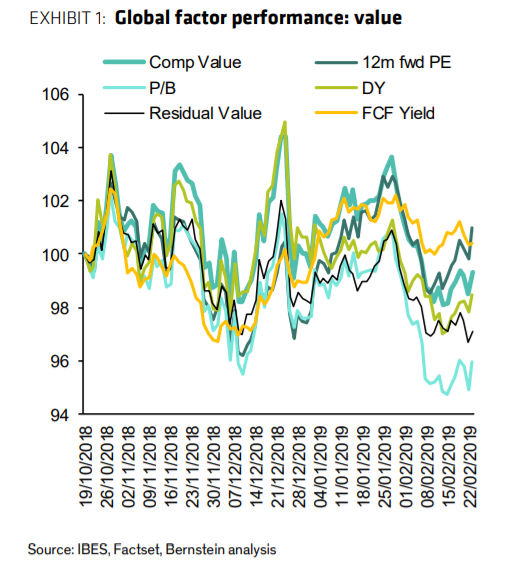
Case in point: Cheaply priced stocks are getting cheaper as expensive stocks have gotten extremely pricey, pushing the valuation gap to the widest in 70 years, according to AB Bernstein. The record dispersion puts cheap equities in a sweet spot as other pockets of the market start losing the appeal because of their high prices.

show chapters Intel is cheap for a reason, investor says Intel is cheap for a reason, investor says    5:42 PM ET Fri, 22 Feb 2019 | 02:11
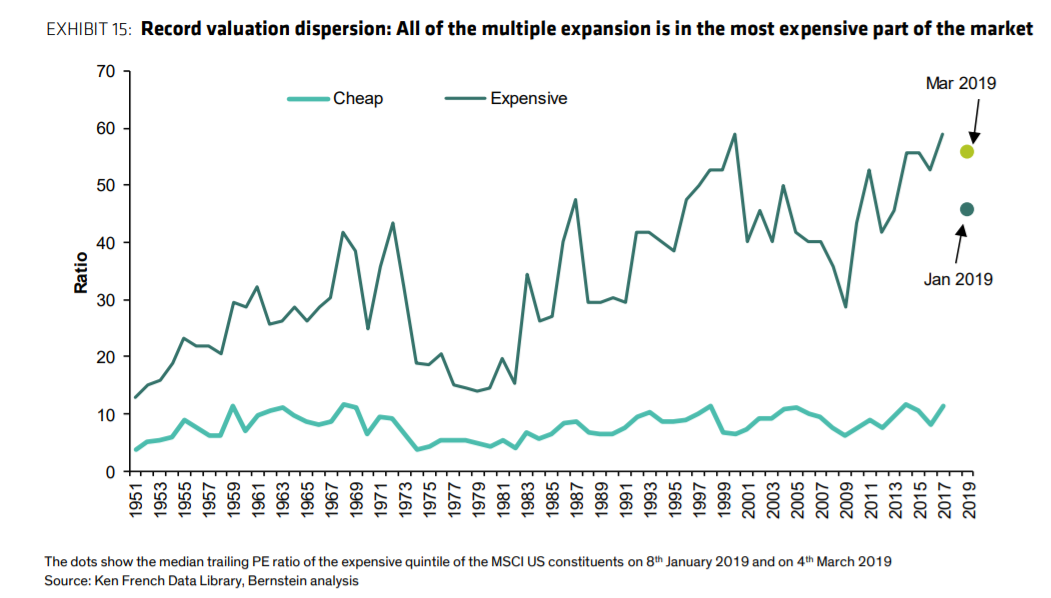
"Value tends to outperform when dispersion in valuations across the market is at its widest," said Bernstein's Inigo Fraser-Jenkins in a note on Wednesday. "Valuation spreads are incredibly wide and sentiment may have found a floor. This provides a support for value within the market contrasted with traditional asset classes which are mostly fully valued."

The stock market has staged a strong comeback, with the S&P 500 notching the best two-month start to a year since 1991, but value stocks seemed to have missed the rally. According to Bernstein, the composite value stocks lost 1.04 percent year-to-date, versus the S&P 500's more than 11 percent gain. Many have argued that the market rebound is not fundamentally driven, as earnings and growth expectations have come down.

"Value as a style tends to perform better than average when there have been extreme troughs in the earnings revisions balance series particularly 6 to 12 months following the point of most aggressive downgrades," Fraser-Jenkins said.

Wall Street analysts have been aggressive when it comes to slashing their earnings expectations. The estimates for the S&P 500's first quarter earnings have dropped 6.5 percent in the first two months of 2019 alone, the largest cut since the first quarter in 2016, according to FactSet. Analysts are projecting an earnings loss of 3.2 percent in the first quarter and a gain of 4.1 percent for 2019.

Bernstein said investors could buy cheap individual stocks in different sectors, or they could buy stocks that are "cheap per unit fundamentals," their so-called "residual value factor."

The stocks that screen well on residual value and are also rated outperform by Bernstein analysts include Imperial Brands, DowDuPont, Goldman Sachs and Micron Technology.

WATCH: Chip stocks are ripping in 2019

show chapters Chip stocks are ripping in 2019, can Nvidia's earnings report keep the rally going? Chip stocks are ripping in 2019, can Nvidia's earnings report keep the rally going?    6:00 PM ET Wed, 13 Feb 2019 | 03:43

Wednesday, March 6, 2019

Microsoft Has a Bold Plan to Reach More Gamers

Even the best-selling consoles in history haven't reached 200 million units sold. In fact, aside from PlayStation 2 at about 160 million, even the bigger success stories have sold closer to 100 million total consoles than 200 million.

In a world where Microsoft (NASDAQ:MSFT) executives estimate there to be 2 billion gamers, according to Geekwire that means that proprietary consoles address only a small portion of the market. And while the company no longer releases Xbox One sales figures, that console has probably sold in the ballpark of 45 million to 50 million units, leaving approximately 1.95 billion customers not available to Microsoft.

"We know we aren't going to sell 2 billion consoles, and there are a lot of markets around the world where a console is not necessarily part of the lifestyle," said Kareem Choudhry, Microsoft's gaming cloud vice president, during a tour of Microsoft's gaming facilities in Redmond, Washington, that Geekwire covered.

During the tour, Choudhry showed off the company's progress on Project xCloud, an effort to move its games off consoles that it began working on in 2018. This project would move the processing power needed for top-tier games to the cloud, making it possible to play them on any device.

A Microsoft sign

Microsoft welcomed reporters to its Redmond, Washington, campus. Image source: Microsoft.

What is Microsoft doing?

Before Satya Nadella took over as CEO from Steve Ballmer, Microsoft had been operating a mostly closed ecosystem. Aside from offering some of its software -- Office and Skype, for example -- for Apple, it generally made customers buy Windows machines (or an Xbox) to gain access to the latest versions of its software, games, and apps.

Nadella changed that by accelerating efforts to bring the best versions of all the company's products to any platform that wanted them. Ballmer should get credit for starting that process by bringing the Office apps to Android, but it was Nadella who has preached an any-device, any-customer strategy.

Project xCloud would do that for gaming, bringing the company's software (i.e., games) to people using tablets, phones, PCs, and who knows what other devices. Using Microsoft's Azure cloud platform, the company hopes to make streaming gaming available on 4G and eventually 5G networks. It laid out its broad goals in a blog post Choudhry made back in October:

Scaling and building out Project xCloud is a multi-year journey for us. We'll begin public trials in 2019 so we can learn and scale with different volumes and locations. Our focus is on delivering an amazing added experience to existing Xbox players and on empowering developers to scale to hundreds of millions of new players across devices. Our goal with Project xCloud is to deliver a quality experience for all gamers on all devices that's consistent with the speed and high-fidelity gamers experience and expect on their PCs and consoles.

Microsoft isn't abandoning the Xbox. It has a lower-cost version in development and still offers Xbox All Access as a subscription offer that includes a gaming console. In addition, gamers playing over xCloud can use Xbox accessories, including controllers to enhance game play.

Why is this important?

The tour of the company's gaming facilities shows that Microsoft hasn't backed off this plan. That's good news for investors, as consoles are generally not money winners -- selling games is where the money is. Going to the cloud means the company can sell a lot more games.

This idea is also a win for gamers, who may soon get access to more titles without having to own multiple consoles. And a bigger addressable market could cause Microsoft to lower game prices. Why charge $60 for a game and limit the audience if it can sell more than six times as many copies at $10?

Microsoft has shown that it's willing to open its doors to a bigger audience. Project xCloud does that in gaming, and that should help the company sell a lot more games.

Tuesday, March 5, 2019

Nordstrom's Q4 Earnings Report Was Better Than It Looked

Over the past decade, Nordstrom (NYSE:JWN) has been one of the most forward-thinking department stores in terms of rolling out new technology and testing innovative ways to serve customers. However, you wouldn't know it from the company's financial results.

On Thursday, the upscale retailer reported disappointing sales results for the final quarter of fiscal 2018. As a result, Nordstrom's full-year operating margin declined, extending its streak of margin erosion to seven consecutive years. Nevertheless, there were several bright spots in the company's earnings report, and its outlook for fiscal 2019 and beyond that should give investors confidence about the future.

A disappointing end to the year

Nordstrom stock rallied to a multiyear high last fall, after the company reported that comp sales rose 4% in the second quarter of fiscal 2018, giving investors hope that sales growth was finally accelerating. However, comp sales increased just 2.3% in the third quarter, as full-line sales growth slowed to a crawl.

This trend has worsened in recent months. In January, Nordstrom reported a 1.3% comp sales gain for the November-December holiday period, including tepid 0.3% comp growth for its full-line business.

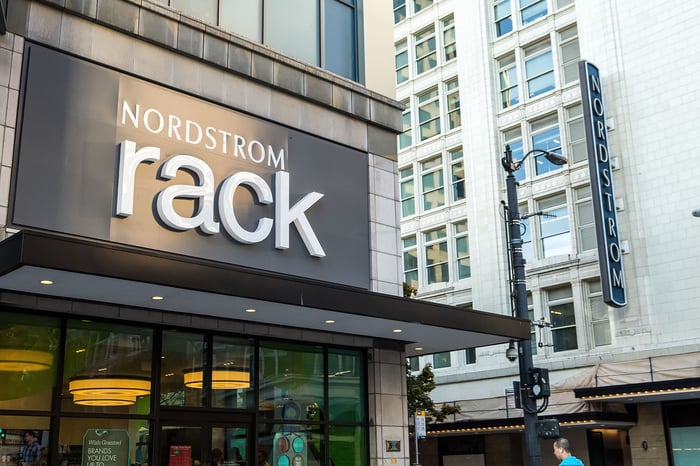
The entrance to a Nordstrom Rack store, with a full-line Nordstrom store in the background

Nordstrom Rack is growing much faster than Nordstrom's full-line business. Image source: Nordstrom.

Nordstrom's Q4 earnings report revealed that the full-line sales slowdown worsened in January. For the quarter as a whole, full-line comp sales fell 1.6%, almost completely offsetting the comp sales growth generated by Nordstrom's off-price business.

Despite the subpar sales results, Nordstrom beat analysts' estimates and its most recent forecast with earnings per share of $1.48 last quarter. That brought its full-year adjusted EPS to $3.60. A favorable income tax adjustment added $0.05 to EPS, driving much of the outperformance.

Nordstrom Rack is still on track

One piece of good news for investors is that the Nordstrom Rack chain, along with Nordstrom's online off-price business, is performing well again. Nordstrom has reported comp sales growth of at least 4% in its off-price business for three consecutive quarters now, following bumpy results over the previous several quarters.

Nordstrom's off-price operations have consistently produced higher growth than its full-line business. Off-price accounted for just over a third of the company's revenue in fiscal 2018, up from less than a quarter of its business five years earlier.

Nordstrom Rack and the online off-price business will probably continue to outgrow the full-price business over the long term. As Nordstrom's sales mix shifts toward this higher-growth channel, its total sales growth should accelerate.

Some stores are a lot better than others

Nordstrom's full-line business is also in better shape than it may seem. While comp sales growth has ranged from slow to nonexistent in recent years, performance varies quite widely from store to store.

For example, the Nordstrom store in Norfolk, Virginia -- one of three that will close in 2019 -- has seen sales crash from $26 million in 2012 to just $11 million in 2017. Nordstrom will need to continue paring down its full-line store fleet in the coming years to rid itself of other locations that are serial underperformers.

By contrast, Nordstrom's new "local market" strategy in Los Angeles appears to be off to a great start. The company has opened several small-format "Nordstrom Local" service hubs in the Los Angeles area since late 2017 to improve customer service. It is also deploying enhanced e-commerce functionality, including faster deliveries, in this key region. The result has been "outsize market share gains in this market," according to management. Nordstrom is likely to bring a similar approach to New York when it opens its Manhattan flagship store this fall.

A rendering of the Nordstrom Manhattan flagship store

Nordstrom's Manhattan flagship store is scheduled to open in late October. Image source: Nordstrom.

Furthermore, the Nordstrom.com e-commerce site is extremely successful, generating perhaps a third of the company's full-line sales, including buy-online, pick-up-in-store orders. As online sales, top-performing stores, and big cities where Nordstrom can deploy its local market strategy start to represent a bigger proportion of the full-price business, overall sales trends will likely improve.

Investments will really pay off after 2019

A third reason for optimism is that Nordstrom is finally reaching the end of a long investment cycle this year. Since 2012, Nordstrom has incurred hundreds of millions of dollars of losses -- not to mention investing over $1 billion -- to enter new lines of business that are expected to drive long-term sales and earnings growth.

In fiscal 2018, Nordstrom got $1.9 billion in revenue from its online off-price business, the Trunk Club clothing subscription box service, Nordstrom Canada, and the first phase of its Manhattan flagship. However, these "generational investments" collectively lost $140 million before taxes.

In 2019, Nordstrom expects to spend $900 million on capex as it completes its main flagship store in Manhattan and continues the rollout of its local market strategy in Los Angeles. Going forward, annual capex will recede to $600 million or less. Meanwhile, Nordstrom's generational investments are expected to produce a $125 million pre-tax loss this year, but these losses should recede quickly in the next few years, with breakeven coming by 2022 and profitability thereafter.

Lots of long-term upside

Nordstrom expects its adjusted operating profit to increase modestly in fiscal 2019, even with sales growth of just 1% to 2%. Sales growth and profit growth should accelerate starting in fiscal 2020 -- when Nordstrom will get the full-year benefit of its new Manhattan flagship store and ongoing West Coast supply chain investments -- with further gains in the following years as its generational investments mature.

Nordstrom has also started to ramp up its buyback program again, spending $678 million on share repurchases last year. This allowed it to reduce its share count by more than 5% by year end. The pace of buybacks will probably slow in 2019 because of higher capex this year, but free cash flow is set to leap higher after 2019, paving the way for more spending on share repurchases.

Between buybacks and organic sales and earnings growth, Nordstrom has a good chance to grow earnings per share at a double-digit annual rate over the next several years. That makes Nordstrom stock -- which currently trades for less than 13 times forward earnings -- look like a steal right now.

Monday, March 4, 2019

OPKO Health Inc (OPK) Files 10-K for the Fiscal Year Ended on December 31, 2018

OPKO Health Inc (NASDAQ:OPK) files its latest 10-K with SEC for the fiscal year ended on December 31, 2018. OPKO Health Inc is a diversified healthcare company. Its business includes diagnostics and provision of pharmaceutical products. OPKO Health Inc has a market cap of $1.69 billion; its shares were traded at around $2.74 with and P/S ratio of 1.61.

For the last quarter OPKO Health Inc reported a revenue of $249.8 million, compared with the revenue of $263.5 million during the same period a year ago. For the latest fiscal year the company reported a revenue of $990.3 million, a decrease of 7.2% from the previous year. For the last five years OPKO Health Inc had an average revenue growth rate of 76.7% a year.

The reported loss per diluted share was 27 cents for the year, compared with the loss per share of $0.41 in the previous year. The OPKO Health Inc had an operating margin of -16.78%, compared with the operating margin of -26.56% a year before. The 10-year historical median operating margin of OPKO Health Inc is -76.43%. The profitability rank of the company is 4 (out of 10).

At the current stock price of $2.74, OPKO Health Inc is traded at 94.4% discount to its historical median P/S valuation band of $48.85. The P/S ratio of the stock is 1.61, while the historical median P/S ratio is 28.42. The stock lost 13.84% during the past 12 months.

CEO Recent Trades:

CEO & Chairman, 10% Owner Phillip Frost bought 200,000 shares of OPK stock on 02/28/2019 at the average price of $2.48. The price of the stock has increased by 10.48% since.

For the complete 20-year historical financial data of OPK, click here.

Sunday, March 3, 2019

BP Capital Fund Advisors LLC Takes $651,000 Position in Tellurian Inc (TELL)

BP Capital Fund Advisors LLC purchased a new position in Tellurian Inc (NASDAQ:TELL) in the fourth quarter, according to its most recent 13F filing with the Securities and Exchange Commission (SEC). The firm purchased 93,725 shares of the oil and gas producer’s stock, valued at approximately $651,000.

A number of other large investors also recently bought and sold shares of the business. PNC Financial Services Group Inc. grew its holdings in shares of Tellurian by 280.0% during the fourth quarter. PNC Financial Services Group Inc. now owns 3,800 shares of the oil and gas producer’s stock valued at $27,000 after buying an additional 2,800 shares during the last quarter. GWM Advisors LLC acquired a new position in shares of Tellurian during the fourth quarter valued at about $79,000. Fox Run Management L.L.C. acquired a new position in shares of Tellurian during the fourth quarter valued at about $123,000. LPL Financial LLC grew its holdings in shares of Tellurian by 148.7% during the fourth quarter. LPL Financial LLC now owns 31,528 shares of the oil and gas producer’s stock valued at $219,000 after buying an additional 18,850 shares during the last quarter. Finally, California Public Employees Retirement System grew its holdings in shares of Tellurian by 27.1% during the second quarter. California Public Employees Retirement System now owns 41,083 shares of the oil and gas producer’s stock valued at $342,000 after buying an additional 8,758 shares during the last quarter. Institutional investors and hedge funds own 19.62% of the company’s stock.

Get Tellurian alerts:

Shares of TELL traded down $0.28 during trading hours on Friday, reaching $9.98. 31,685 shares of the stock traded hands, compared to its average volume of 1,912,625. The company has a debt-to-equity ratio of 0.17, a current ratio of 4.61 and a quick ratio of 4.61. Tellurian Inc has a 52 week low of $5.90 and a 52 week high of $12.45. The firm has a market capitalization of $2.42 billion, a P/E ratio of -11.90 and a beta of 2.01.

In other news, Director Don A. Turkleson purchased 83,897 shares of the company’s stock in a transaction that occurred on Tuesday, December 11th. The shares were bought at an average cost of $6.75 per share, with a total value of $566,304.75. Following the completion of the transaction, the director now directly owns 126,121 shares of the company’s stock, valued at $851,316.75. The acquisition was disclosed in a legal filing with the Securities & Exchange Commission, which is available at this hyperlink. Also, Director Don A. Turkleson purchased 42,320 shares of the company’s stock in a transaction that occurred on Monday, December 17th. The shares were purchased at an average cost of $6.75 per share, for a total transaction of $285,660.00. Following the completion of the transaction, the director now directly owns 172,224 shares of the company’s stock, valued at $1,162,512. The disclosure for this purchase can be found here. Insiders have purchased 130,000 shares of company stock worth $877,500 over the last three months. 44.80% of the stock is owned by insiders.

TELL has been the subject of a number of analyst reports. Zacks Investment Research cut shares of Tellurian from a “hold” rating to a “sell” rating in a report on Thursday, February 21st. Scotiabank initiated coverage on shares of Tellurian in a report on Friday, February 8th. They set a “sector perform” rating for the company. Credit Suisse Group reduced their price objective on shares of Tellurian from $15.00 to $12.00 and set an “outperform” rating for the company in a report on Wednesday, November 14th. BidaskClub upgraded shares of Tellurian from a “hold” rating to a “buy” rating in a report on Wednesday, January 9th. Finally, Wolfe Research initiated coverage on shares of Tellurian in a report on Tuesday, November 13th. They set a “market perform” rating for the company. One analyst has rated the stock with a sell rating, four have given a hold rating, five have given a buy rating and one has issued a strong buy rating to the stock. The stock presently has an average rating of “Buy” and an average target price of $12.13.

ILLEGAL ACTIVITY NOTICE: This news story was first posted by Ticker Report and is the sole property of of Ticker Report. If you are reading this news story on another publication, it was illegally copied and reposted in violation of United States & international trademark and copyright laws. The legal version of this news story can be viewed at https://www.tickerreport.com/banking-finance/4189706/bp-capital-fund-advisors-llc-takes-651000-position-in-tellurian-inc-tell.html.

About Tellurian

Tellurian Inc plans to develop, own, and operate a natural gas business and to deliver natural gas to customers worldwide. The company is developing a portfolio of natural gas production, liquefied natural gas (LNG) trading, and infrastructure that includes an approximately 27.6 million tons per annum LNG export facility and an associated pipeline.

Featured Story: How Important is Technical Analysis of Stocks

Want to see what other hedge funds are holding TELL? Visit HoldingsChannel.com to get the latest 13F filings and insider trades for Tellurian Inc (NASDAQ:TELL).

Institutional Ownership by Quarter for Tellurian (NASDAQ:TELL)

Saturday, March 2, 2019

Cision Ltd. (CISN) Q4 2018 Earnings Conference Call Transcript

Logo of jester cap with thought bubble.

Image source: The Motley Fool.

Cision Ltd.  (NYSE:CISN)Q4 2018 Earnings Conference CallFeb. 28, 2019, 5:00 p.m. ET

Contents: Prepared Remarks Questions and Answers Call Participants Prepared Remarks:

Operator

Good afternoon. And welcome to Cision Limited Fourth Quarter 2018 Earnings Conference Call. All participants will be in listen-only mode. (Operator Instructions) After today's presentation, there will be an opportunity to ask questions. Please note this event is being recorded.

Before we get started, we need to remind everyone that in our calls, we'll be making some statements that are not based on historical fact, including statements about management's beliefs or expectations. These statements are forward-looking statements within the meaning of Section 27A of the Securities Act and Section 21E of the Securities Exchange Act and relate to among other things our expected operating results in 2019 outlook.

Our integration of Falcon and TrendKite and the realization of expected benefits from the transactions, our business strategy and other matters relating to our business. These forward-looking statements are intended to be covered by the Safe Harbors created by the federal securities laws. Forward-looking statements are subject to known and unknown risks, uncertainties and other factors that may cause our actual operating results, financial position or performance to be materially different from those expressed or implied in our forward-looking statements.

We believe that all forward-looking statements are based upon reasonable assumptions. However, we caution that you should not place undue reliance on these statements. We disclaim any obligation to update these forward-looking statements. For additional information concerning factors that could affect our financial results or cause actual results to differ materially, please refer to the cautionary statements included in our filings with the SEC and the sections entitled risk factors, including the risk factors set forth in our most recent Annual Report on Form 10-K, in which we discuss some important assumptions and business risks that could cause our actual results to differ materially from those in our forward-looking statements.

In addition, please note that on today's call, in our investor presentation and in our press release issued earlier today, we refer to certain non-GAAP financial measures, including EBITDA, adjusted EBITDA and adjusted net income. These measures are reconciled to the most comparable GAAP measures in our financial statements and can be found in the investor presentation posted on our website under the Investors tab. Investors are cautioned that non-GAAP financial measures are not a substitute for GAAP disclosures and our advised not to place undue reliance on non-GAAP information.

I would now like to turn the call over to Kevin Akeroyd, Cision's Chief Executive Officer to begin the call. Kevin?

Kevin Akeroyd -- Chief Executive Officer

Thank you, operator, and welcome, everyone, to Cision's fourth quarter 2018 earnings conference call. This afternoon, I will begin with some brief remarks regarding our Q4 and FY 2018 performance, I will discuss a few of our recent accomplishments and conclude with an update on our key priorities for the remainder of FY 2019. I will then turn the call over to Jack Pearlstein, our CFO, who will discuss our Q4 and FY 2018 financial results and provide an updated outlook for fiscal year 2019. We will then turn it back over to the operator to kick off the question-and-answer session. Both Jack and I will be also working from the investor presentation that has been posted in the Investors section of our website.

To kick us off today and beginning on Slide 2 of the presentation, I return to the theme of momentum that we discuss in each of our last several earnings calls. We continue to see very solid momentum in our financial performance, momentum in adoption of C3 by our customers and the momentum in the adoption of our industry transforming innovation solutions. Most importantly, Cision ID Impact that allows earned media business results attribution for the first time, in particular impact is enjoying incredible momentum.

With respect to Cision Impact momentum, as you know, we use it as a big cross-sell and C3 adoption driver, bundling certain amount of Impact in when clients adopt both monitoring and PR Newswire inside the C3 subscription. The overall adoption of this bundling has a sitting at over 1,200 clients now using this solution. We continue to enjoy adoption of Impact being paid for above and beyond this bundling as well. We ended Q4 with over 70 clients paying above and beyond and in Q4 Impact had bookings in excess of $1 million in ACV for the first time. We exited the year with pipeline for Impact of several million dollars in ACV again over and above the bundling inside our C3 strategy.

Equally exciting Cision ID's audiences had its first real quarter, with great actual results from some of the world's largest advertisers, who ran paid ad campaigns on top Cision Audiences and got great results. As Cision rapidly becomes the only solution provider in the world that can allow the CMO and the CCO to execute campaigns and customer dreams across paid, owned and earned media, these results are encouraging to say the least.

As noted in our earnings release this afternoon, we delivered a very solid fourth quarter of 2018. Our Q4 revenue adjusting for the impact of purchase accounting came in at 164, excuse me, $186.4 million, representing core organic revenue growth of 2% versus the prior year. Excluding the results of our email marketing business, which we divested in Q1 of 2019, core organic revenue growth was 2.9% versus the prior year.

Our Q4 adjusted EBITDA was also strong, coming in at $68 million, up 11.1% versus the prior year. Our adjusted EBITDA margins in Q4 were 36.5% better than expectations for the quarter due to strong cost synergy realization. The strength of the overall business in Q4 provides us with a lot of confidence in our outlook as we move into 2019.

In addition to delivering on the financial side of the business. We also saw continued progress against our innovation priorities and making Cision the transformative cloud technology platform leader for their earned, media and communications markets. Our total number of C3 customers at December 31, 2018 was just over 9,800, a solid end to FY -- excuse me, FY 2018. This rate of adoption continues to be great validation of pent-up demand in the market. As I mentioned above our innovation solutions had a great first year.

I mentioned the Cision ID Impact and Cision ID Audience stellar momentum above Image IQ, which launched this quarter had 256 clients adopt in a little over two months of selling. As a reminder, Image IQ is the technology that allows our clients to do monitoring and analysis on the brands images and logos, not just text and hash tags. In a world where all media, not just earned media becomes increasingly visual and image-based and less and less text based. This will become more important to CMOs and CCOs and Cision's competitors do not have this capability. So we expect this to become increasingly more important differentiation for C3 moving forward.

We continue to drive customers down as overall solution past. We use C3 as the communications technology platform, Cision Impact is there analytics and business results attribution and Cision Audiences not only improved performance of the much larger paid known budgets, but also to execute integrated campaigns across paid, owned and earned media with Cision ID as the backbone. We remain confident, this strategy will enable us to continue to consolidate share in existing TAM, plus it's growing into the much larger adjacent marketing advertising TAMs. We also believe that this integrated platform attribution and data solution create stickiness is critical for improved revenue retention rates and increased ARPU. This has been our core strategy for the last two years and the exciting progress made this quarter has further validated that strategy.

Slide 3, Cision's number one strategic priority continues to be accelerating organic growth rate across the business. Organic growth in 4Q was driven by strong performance in the Americas, up 3.8% and APAC, up 13.9%. Offset by weakness in EMEA, which was down 5.9% on declines in volume-based media monitoring, with the exception of our EMEA region, we made measurable progress on this front in 2018, by driving bundled sales of software analysis and distribution to both new and renewal customers. Our core Americas business grew 4.4% in 2018, excluding our email marketing business, which is our strongest rate of growth in four years in that region.

Distribution revenues were strong in 2018, as our cross-sell bookings of software distribution and insights. Our APAC region was up 19% organically on a consistent currency basis in 2018. Turning in another very solid year performance across software distribution and insights. We had the best cross-selling bookings quarter-to-date in the US, posting $5.4 million in booked ACV, up 55.1% increase versus Q4 2017. The lone area of (ph) weakness was our EMEA region, which was down 2.2% on a constant currency basis in 2018, as volume based transactional media monitoring weakness in the UK and France, offset solid performance in the Nordics and the rest of the region. We began to get good traction on the execution of our strategy of migrating monitoring customers in the UK and France to subscription agreements from variable arrangements and with our recent additions of Peter Low and Keir Fawcus from Kantar, we expect to see these two markets turn around quickly for us in 2019.

Shifting to Slide 4, subscription customer growth in Q4 was approximately 4.2% versus the prior year, driven both by strong new business wins and steady conversions of transaction contracts to subscription contracts. ARPU per subscription customer declined slightly by approximately 1.3% due to the robust performance by shifting transactional PR Newswire customers to subscription customers. This is very good for the business. But unfortunately those come at lower ARPU and when you combine that with pricing incentives you used to convert transactional monitoring contracts to subscription in the UK and France, this metric took a slight hit. Transaction trends remained as expected and for our strategy, with a number of customers transacting with us during the quarter declining, the transaction revenue per customer during the quarter increasing substantially, much more than the number of customer decline.

Our second priority is to further differentiate our category-leading product and service offering, we continue to add features and integration to Cision Communications Cloud or C3 that include enhanced social analytics, sophisticated image monitoring and analytics, streamlined workflows, superior content discovery and deeper integration back into paid known systems, our clients have invested in the marketing and advertising fronts. We remain committed to ensuring Cision has the most feature-rich platform for PR and corporate comms professionals in the industry, and we will continue to devote significant development resources to enhance our category leading product and service offering that should result in an ever improving customer experience.

Cision ID and the continued rollout of Cision ID derivative products such as Cision Impact and Audiences, is our third strategic priority. Impact, to remind everyone, is our offering that allows clients to show the validated reach, engagement, audience data and actual sales conversion data from customers exposed to earned media, press release content. Cision Audiences is to remind everybody is our offering that allows clients to match Cision ID based data which is individual customer profile through identity resolution and integrate across their paid, owned and earned media campaigns. We continue to make significant progress rolling this offering out and getting in our customer hands.

As I highlighted earlier in the call, we have over 1,200 clients using Impact with a significant number of them being Fortune 500 clients. We continue to experience solid traction across both our sales organization and with our customers and expect to realize meaningful revenue from these products over the next several quarters.

On to Slide 5. Last month represented an extremely fast start to the year for us, but when we believe was truly transformative. In early January we completed our acquisition of Falcon, which meaningful enhances our Earned Media Management with modern social media management and engagement capabilities. In the third week of January, we completed our acquisition with TrendKite, which further extends our leadership position in media monitoring, measurement and attribution. Our current plan is to integrate the best of the C3 platform with the innovative technology, advanced measurement and AI capabilities with the TrendKite platform, thereby creating a new C3.

Lastly, on the transformational front, we sold our email marketing assets to strategic buyer in the third week of January. The sale of the email marketing assets resulted from a detailed review of our long-term business strategy and desire to focus on our industry-leading communications cloud platform. Email marketing business has long been a drag on our top-line performance for the past several years, 70 basis points drag in 2018 and a 90 basis point drag in 2017. The combination of these moves changes our overall growth trajectory, brings in a wealth of new management talent and puts us in a better position than we've ever been to deliver unmatched value in the public relations and marketing communications industry.

So, in summary, an extremely solid fourth quarter 2018, a great end to fiscal year 2018 and we're positioned extremely well to capture the growth opportunities in front of us.

I'll now turn it over to Jack Pearlstein, our CFO, who will provide and discuss our Q4 and FY 2018 financial results and provide an updated outlook for fiscal year 2019. Jack?

Jack Pearlstein -- Executive VP And Chief Financial Officer

Thanks, Kevin. I'll begin with a review of our fourth quarter and fiscal year 2018 financial performance and conclude with an updated outlook for fiscal 2019. A number of the non-GAAP financial measures that I plan to reference have been provided in this afternoon's fourth quarter and FY'18 earnings release, along with our underlying calculations and definitions.

Our Q4 2018 revenue came in at $186.4 million, a 10.3% increase over our Q4 2017 revenue of $169 million. After adjusting for the reduction of GAAP revenue due to purchase accounting, our Q4 2018 revenue was up 9.8% versus the prior year. Core PR revenue on a pro forma and constant currency basis was up approximately 2% versus the prior year fourth quarter. As Kevin mentioned at the top of the call, our strong organic revenue growth in the quarter was driven by exceptional performance in the US, Canada, the Nordics and across our APAC region. We saw solid growth in subscription revenues, transaction revenues and cross-sell bookings during the fourth quarter.

After adjusting for the impact of currency, pro forma organic revenue growth in our Asia-Pac business was up approximately 13.9% in Q4 versus the prior year period. This was a bit slower than last quarter's growth rate, which was expected as we work through the remaining headwinds related to our divestiture of the vintage filings business. We continue to see strong momentum in the region with recent launches of sales efforts in South Korea, Japan and Australia.

After adjusting for both the impact of currency and non-core revenues, pro forma organic revenue growth in the Americas was up approximately 3.8% in Q4 versus the prior year period. As mentioned earlier in the call, we were positively impacted by strong cross-selling, a rebound in transactional revenues and solid sales execution.

After adjusting for the impact of currency, pro forma organic revenue growth in our EMEA business was down approximately 5.9% in Q4 versus the prior year period. The decline was essentially flat from last quarter's decline, the result of continued weakness in our French and UK transactional media monitoring businesses. Our average number of subscription customers in 4Q 2018, excluding email marketing customers was approximately 42,300, roughly 4.2% higher than the average number of subscription customers in the same period a year ago.

The average annualized revenue per subscription customer during 4Q 2018 was approximately $11,100, a 1.3% decline over the prior year period. As Kevin mentioned earlier in the call, this decline was primarily due to a strong PRN transaction to subscription quarter and the pricing incentives used to convert transaction contracts to subscription contracts.

On the transactional side excluding email marketing, we had approximately 39,200 customers transact with us during 4Q 2018, roughly 6% below the same period a year ago. A portion of this decline relates to the conversion of transaction customers to subscription customer. Average revenue for the quarter from customers that transacted with us came in very strong and at approximately $1,530, roughly 8.6% higher than the same period a year ago.

For those of you following along with the online presentation, I'm now going to kick off on slide six, which is cost excluding acquisition costs, intangibles amor and other. Gross margin for 4Q 2018 was 64.3%, included in our cost of revenue for the fourth quarter was approximately $6 million of amortization related to acquired intangibles and approximately $3.5 million impact acquisition related costs and expenses. Excluding these two items, gross margin for 4Q 2018 would have been 69.4%.

For comparative purposes, gross margin for 4Q 2017 was 68.5%, included in our cost of revenue for the fourth quarter of 2017 was approximately $6.5 million of amortization related to acquired intangibles and approximately $0.3 million of acquisition-related costs and expenses. Excluding these two items, gross margin for 4Q 2017 would have been 72.6%.

Acquisition-related costs and expenses during 4Q 2018 were roughly $12.7 million, approximately $3.5 million of these costs were included within cost of revenue, approximately $0.5 million were included within sales and marketing, approximately $0.1 million were included within research and development and approximately $8.6 million were included within G&A.

Acquisition-related costs and expenses during the prior year fourth quarter were $16.7 million, approximately $0.3 million of these costs were included within cost of revenue, roughly $0.5 million were included within sales and marketing, approximately $0.8 million were included within R&D, $14.7 million were included within G&A and approximately $4.4 million were included in other income.

In Q4, as Kevin mentioned, we delivered another solid quarter of adjusted EBITDA, which came in at $68 million. Our focus on overall cost controls and our continued efforts to further drive synergies in the business will continue to be a priority. Adjusted EBITDA margins were 36.5% for the fourth quarter of 2018, a 50-basis-point increase over adjusted EBITDA margins in the prior year period. Adjusted net income for the fourth quarter of 2018 was $31.4 million, a 36.7% increase over the prior year period. Adjusted net income per diluted share for 4Q of 2018 came in at $0.24, a 25.6% increase over the prior year adjusted net income per diluted share of $0.19.

Now on to our updated outlook for fiscal year 2019 in slide seven in the presentation. Due to the many moving pieces and parts involved in the two recent acquisitions and the divestiture of the email marketing business, we are providing guidance this time for both Q1 of 2019 in addition to the full year 2019 in order to help everyone that is running the model. The 2019 and Q1 2019 outlook assume the inclusion of results from our acquisitions of Falcon and TrendKite from the date of their respective acquisitions through December 31, 2019 and the inclusion of results from our email marketing assets from January 1, 2019, till the date of divestiture.

As highlighted in our earnings release this afternoon, we expect full-year revenue of between $775 million and $785 million and Q1 revenue of between $185 million and $190 million. Excluding the impact from purchase accounting, we expect full-year revenue between $782 million and $792 million and Q1 revenue of between $187 million and $192 million.

For FY 2019, the bottom end of the revenue guidance range represents approximately 5% organic revenue growth and the top end of the revenue guidance range represents a bit better than 6% organic revenue growth. For Q1 2019, the bottom end of the revenue guidance range represents a bit better than 4% organic revenue growth and the top end of the revenue range represents a bit better than 6% organic revenue growth.

On Slide 8 of the presentation, we put together a pro forma constant currency core organic revenue growth chart to illustrate the change to our overall growth trajectory after the acquisitions and the divestiture of the email marketing business. Cision on a stand-alone basis, excluding the email marketing businesses do grew 2.4% in 2017 and 3.1% in 2018, a solid improvement of roughly 70 basis points. Including the acquisitions of both Falcon and TrendKite, and again excluding the email marketing business, Cision would have grown approximately 4.4% in 2017 and approximately 5.6% in 2018.

So, in summary, our organic revenue growth guidance for FY 2019 is roughly in line with 2018's overall pro forma growth rate after making these adjustments. We expect adjusted EBITDA of between $270 million and $275 million for FY 2019 and our Q1 adjusted -- Q1 2019 adjusted EBITDA being between $61 million and $63 million. We expect adjusted EBITDA to continue to pick up throughout the remainder of the year, as we realize synergies from the Falcon and TrendKite deals, a significant portion of which we completed last week and as the predominantly subscription-based businesses of the two acquisitions continue to ramp. We expect FY adjusted net income of between $122 million and $125 million, and Q1 2019 adjusted net income of between $28 million and $30 million. We expect FY 2019 adjusted net income per share of between $0.82 and $0.85, and Q1 2019 adjusted net income per share of between $0.19 and $0.20.

Additionally, within the earnings release furnished this afternoon, we provided an updated full-year outlook for a number of other financial items, including depreciation expense, amortization expense, interest expense, cash interest expense, stock-based comp income and CapEx. The outlook items provided on this call, as well as those included in today's earnings release assume exchange rates of 1.29, 1.14 and 0.76, respectively, for the British pound, the euro and the Canadian dollar to the US dollar. Additionally, our outlook for the fiscal year 2019 excludes any additional acquisitions, divestitures for other unanticipated events.

That concludes our prepared remarks. So I'll now turn it back over to the operator to begin the question-and-answer session. Operator?

Questions and Answers:

Operator

We will now begin the question-and-answer session. (Operating Instructions) Our first question comes from Bob Labick with CJS Securities. Please go ahead.

Robert James Labick -- CJS Securities, Inc. -- Analyst

Good afternoon and thanks for taking my questions. Just wanted to start with the -- you talked about this already, but the annualized revenue per subscription customer dipped modestly due to the transition from PR Newswire customers. Could you tell us a little bit about how we should think about that going forward into 2019 and what the drivers of that ARPU will be?

Jack Pearlstein -- Executive VP And Chief Financial Officer

Yeah. Bob, just to recap, right. We put very aggressive subscription versus transactional packages together at the UK and France problem child, right, there was a slight dip and then we had a very strong quarter and finally getting a lot of PR Newswire customers that where transaction was to switch. So again that's extremely good for the business. Because getting that transactional revenue down, down, down and getting the subscription revenue up is good for every reason. But obviously it will be coming at lower ARPUs. So that was -- that's the description. We do not believe that this is going to be in any way a sustained drag on ARPU. We believe that ARPU will go -- continue to go up materially, the way it has the last seven quarters. It's going to have a really nice year this year and will continue to go up even if we continue to have good momentum, driving lower ARPU PRN subscribers over this transaction. So we think we're going to do both and the ARPU is going to go up despite the PRN impact.

Robert James Labick -- CJS Securities, Inc. -- Analyst

Okay. Great. That's helpful. And then kind of bigger picture, between Cision ID and Trendkite, about how many of your subs are now using attribution and then -- of your 42,000 or so how many is attribution applicable to?

Jack Pearlstein -- Executive VP And Chief Financial Officer

So between Trendkite and Cision, it's almost 1,500 now. They're using it. So it's a big number of customers. That's a good underscore, that says, hey, the market was really ready for PR attribution, it wasn't just a good idea, when the companies came out with it, the customers starting to get adopting it, Bob. And quite frankly, that's a universal need. Even if I'm a 50 person shop, let's say, we see that (ph) company, if I can go in and if I'm a B2B buyer and I can go in and show my CFO and CMO and CEO, and I can track pipeline to PR or I can track e-commerce revenue the articles being written. That's pretty universal, Bob. So if universally needed for just about everybody that's on a subscription base, there is a price point issue, right. So it's going to be some subset of that. But for the most part, you should start seeing this scale very, very aggressively, because it's not a limited to small, medium, large, it's not limited to B2B or B2C, it's not limited to a certain vertical industry, it's not limited to a certain geography. This is something that the entire industries need. So we think this thing is going to scale and it's got a very high ceiling.

Robert James Labick -- CJS Securities, Inc. -- Analyst

Great. I'll get back in queue. Thank you.

Kevin Akeroyd -- Chief Executive Officer

Thank you, Bob.

Operator

Our next question comes from Michael Turrin with Deutsche Bank. Please go ahead.

Michael James Turrin -- Deutsche Bank AG -- Analyst

Good afternoon. Thanks. First, on the organic revenue growth side, I think you provided some useful details here around 5% to 6% for next year. It sounds like even maybe above 6% and then 4% to 6% for the range in Q1. Is there any additional color you are able to provide around expected seasonality of that trajectory throughout the year. Is it fair for us to assume that continues to step up or how would you think about it from our perspective?

Jack Pearlstein -- Executive VP And Chief Financial Officer

I think, just given the sheer size of the distribution business still under the hood, you're still likely to see bigger quarters in Q2 and Q4, and smaller quarters in Q1 and Q3. I think, the impact of that seasonality gets a little bit muted. As you think about the two businesses that we just acquired. They are really kind of 100% SaaS businesses, very focused on MRR and those should continue to step up month-to-month and quarter-to-quarter. So I still think you'll see a little seasonality, as I described, but it will be somewhat muted versus sort of prior years.

Michael James Turrin -- Deutsche Bank AG -- Analyst

Perfect. That's helpful. And then, maybe -- can you walk us through where you are today post-Trendkite and Falcon from a leverage ratio perspective? I mean, how much optionality do you still have left and how are you thinking about the balance sheet and capital allocation going forward?

Jack Pearlstein -- Executive VP And Chief Financial Officer

Yeah. I mean, I think, we're still in the mid 4s, right. When you look at net debt-to-EBITDA. We provided a little bit of color on that in the earnings press release, just so everybody could see how we finance the transactions and where debt sits today. Given, the free cash flow in the business, we think we'll continue to delever throughout the year. We still think that there's a chance to end the year at something with a three on the front in terms of net debt-to-EBITDA versus a 4, if not, it's probably a quarter delayed, given the acquisitions from what we've previously talked about with folks on the call. And in terms of capital allocation, I think, our focus right now is squarely on organic growth continuing to work through the synergies in front of us. And I think acquisitions are really often the future for us, we've got lots to do and lots on our plate to execute.

Michael James Turrin -- Deutsche Bank AG -- Analyst

Got it. I appreciate you taking the question. Thanks.

Operator

Our next question comes from Dan Hedberg with RBC Capital Markets. Please go ahead.

Daniel Robert Bergstrom -- RBC Capital Markets, LLC -- Analyst

Okay. Thanks. Actually it's Dan Bergstrom for Matt Hedberg. So little jumbled there. But, hey, another question on organic revenue growth rate and thanks for the additional color on seasonality that you just provided there. Thinking through kind of the guided range for the year, what could get you to the upper end of the range.

Jack Pearlstein -- Executive VP And Chief Financial Officer

What could have us wind up at the top of the range?

Daniel Robert Bergstrom -- RBC Capital Markets, LLC -- Analyst

Yeah.

Jack Pearlstein -- Executive VP And Chief Financial Officer

Or over the top of the range?

Daniel Robert Bergstrom -- RBC Capital Markets, LLC -- Analyst

Sure.

Jack Pearlstein -- Executive VP And Chief Financial Officer

Yeah. I mean, look, we've had some pretty good success as of late with cross-sell. We've had some nice sizable transactions with respect to cross-sell. We've continued to make progress on retention rates improving and we bought some nice businesses here that we think are going to play well with the customer base. So I would say, if we execute, I think, we certainly have a chance to continue the momentum and hit the top end of the guidance range and who knows, maybe even exceed it.

Kevin Akeroyd -- Chief Executive Officer

I would add one thing there and that is, we have the Cision ID Impact attribution in the audiences, to remind everybody to listen the story for a little bit. This is basically what happened in digital advertising. It just finally happening over here in earned media. And there is going to be an inflection point and Jack and I have not counted on that inflection point hitting in 2019 at all. We've got that out in the next decade and I think we're planning properly conservatively.

But right the budgets, when all the sudden you become a revenue-driving function instead of a cost center, which is what impact that. And when all the sudden Cision IDs are driving double-digit improvements in performance on the much larger ad budgets. That's a feels it could give it (ph). Again, we're not forecasting it in the guidance, but when you want to look at where high deltas are and big, big pockets of money in the buying audiences. That's the other variable that could fall materially for us if that adoption rate gets faster and bigger than what we got into the plan.

Daniel Robert Bergstrom -- RBC Capital Markets, LLC -- Analyst

Great. And then with the start to the new calendar year here in a couple new assets. Just curious if you've changed anything from a sales force perspective.

Kevin Akeroyd -- Chief Executive Officer

Just rapid integration, right? I didn't need the Trendkite and Cision rep count in the same accounting here (4400) area code 212 or area code 415 or area code, right, you name it. So, right, the large sales organizations we had duplicative management and we had duplicative rep coverage across especially US and Canada and London. So streamlining and elimination of redundancy and collapsing the two awards that we head into March with one sales org not two. That's right sized, while still maintaining the appropriate level of coverage.

Daniel Robert Bergstrom -- RBC Capital Markets, LLC -- Analyst

Great.

Robert James Labick -- CJS Securities, Inc. -- Analyst

2018 part of the synergy exercise that Jack referenced last week. We got a large chunk of it out already and that was a non-attributable part of it.

Daniel Robert Bergstrom -- RBC Capital Markets, LLC -- Analyst

Thank you.

Operator

Our next question comes from Dan Salmon with BMO Capital Markets. Please go ahead.

William Lowden -- BMO Capital Markets -- Analyst

Hi, everyone. This is William on for Dan. Thanks for taking the question. Two from me. First, following up on the attribution Cision ID, could you go in a little more detail around when it's being paid for on a stand-alone basis and exactly how that works, I always thought of that is more of being bundled in with C3, but it sounds like you've got 70 stand-alone paying clients? And then, second, to the extent you can -- can you quantify how much EBITDA your email business generated last year and how much -- what you're losing this year? Thanks.

Kevin Akeroyd -- Chief Executive Officer

I'll take the first and I'll let Jack take the second one. Again, a reminder to everybody on the call, impact is basically based on how much earned media a customer wants to track. So if I'm a large customer, the amount of Impact we're bundling in essentially approximates about 5,000 articles or press releases a year. So that if you want to track, right, the validated reach, the demographic B2B or the demographic B2C or firmographics B2B audiences and track that all the way down to a website visit or e-commerce purchase or B2B pipeline are closed one sale, that's the amount of articles.

For large companies, they obviously get way more coverage in that, right. We've got customers that get a million hits a year, not 5,000 in the year. So for our customers that say, gosh, we love the bundle, thank you for including that, but I'm going to burn through those 5,000 articles in about three weeks and I don't want to limit the impact, I need to track impact for my entire year. That's the example of the customer that's saying thank you for it, I'll take it, but I wanted for my entire universe, I don't want to for three weeks' worth and when customers get the value properly, they want it for everything, not just a 5,000 that's included in the bundle, that's when they go ahead and open up the purse strings and those are the 70 people that are paying the full subscription rate and why it had such a nice bookings quarter last quarter. Hopefully, that makes sense.

William Lowden -- BMO Capital Markets -- Analyst

That makes perfect sense.

Kevin Akeroyd -- Chief Executive Officer

And Jack, why don't you take the second part?

And EBITDA.

Jack Pearlstein -- Executive VP And Chief Financial Officer

Yeah. I would say, after adjusting for shared costs, it's probably in the neighborhood of $8 million.

William Lowden -- BMO Capital Markets -- Analyst

Perfect. Thanks so much guys.

Operator

Our next question comes from George Tong with Goldman Sachs. Please go ahead.

George Tong -- Goldman Sachs -- Analyst

Hi. Thanks. Good afternoon. You're now one quarter in integrating Falcon and Trendkite, can you discuss early traction you've had in bundling and cross-selling these products with your C3 platform?

Kevin Akeroyd -- Chief Executive Officer

A partial quarter, right. One of them closed early January, one of them close at the end of January, so hasn't been quite a full quarter. But, yeah, we've been really busy. Again, as Jack mentioned, we got extremely aggressive and we have done very, very quickly a very large part of the synergies to make sure that we get the cost out and to maintain the EBITDA percentages that are in the guidance, while buying businesses basically didn't deliver a very good the business. So that was huge number one.

Number two is the organizational alignment, we literally have completed globally the entire organizational structure, not just in sales, but across the Board. So all what we design has done virtually all the synergy, not, almost all the synergy has done and now it's about integration. So integration tends to go like this. You get integrated bundles out before you can actually write the code do integration. So Phase 1 which you are already doing is offering promotions and advantaged bundles of offerings pre-technical integration by both sales teams, so there's immediate benefit to the client base. Phase II will obviously be integrated offerings and Phase III will be, hey, it's just all in one platform, so it requires R&D and actually code to be written, an integration to be get done for Phase II and III, which you can't get done in two months. However, we're already market with Phase 1, which is aggressive bundled offerings for customers on both sides to give immediate benefit for Falcon and Cision and Trendkite all to be in the same family and that's in market now.

George Tong -- Goldman Sachs -- Analyst

Very helpful. And as a follow-up, you've indicated that you are seeing weakness in the French and UK region still with your transaction revenues. Can you talk about when you expect some of these headwinds to subside?

Kevin Akeroyd -- Chief Executive Officer

Yeah. Again to remind everybody that is, those are the two markets left for people literally by a radio clip or TV clip or newspaper clip by the drink, right? They literally pay per article per clip. That is where we saw the softness as people's willingness to go, they either buying 100 newspapers or the clips instead of 400 newspapers now and they're buying the top 50 TV stations and radio stations instead of the top 500 TV and radio stations to get out of that variable expense.

As Jack and I mentioned on the call, we have seen significant momentum, we got some good adoption on the subscription packages, which -- and again, which is part of why, right, the ARPU did what it did. The PR Newswire impact was a bigger impact in this. But we got real traction. It just takes a little while for it to flow through the P&L. So that was a long-winded answer.

The short answer is, it would might take nice slow improving steps over the next four quarters and we expect to get it out of the system this fiscal year, but it won't come all the way out of the system in Q1.

George Tong -- Goldman Sachs -- Analyst

Got it. Very helpful. Thank you.

Kevin Akeroyd -- Chief Executive Officer

Yeah.

Operator

Our next question comes from Rob Oliver with Baird. Please go ahead.

Matthew Steven Lemenager -- Robert W. Baird & Co. Incorporated -- Analyst

Great. Thanks. It's Matt Lemenager on for Rob. I have -- Kevin, I have a question on Cision Impact. I appreciate all the color you've given so far. So the -- well, I'm curious of the 70 clients about $1 million in bookings. Is it fair to think about it as kind of that like $14,000 on average for that ARPU when the customer takes the full subscription, or is that not the right way to think about it? And then how could that ARPU kind of change or trend over time?

Kevin Akeroyd -- Chief Executive Officer

Well, it is. And again, I don't need to do the simple algebra for everybody, boy, if we could just scale that 14K on top of the 11K that more than doubled the ARPU, which is a huge part of the strategy. So everybody should be excited about that number. In reality, it's a bit lumpier than that. Because again it's predicated on, again, the largest airplane manufacturer in the industry doesn't get as much coverage as the largest CPG player in the industry even though they are about Fortune 10 companies. So there's a little bit of variability there based on what kind of business I'm in and then, therefore, how much coverage I need to track, but you are on the right track. So it's going to -- the sausage is making a little lumpier than that, but is it going to average out of the scales to be at least that kind of ARPU impact on top of the 11K, the answer is yes, and fingers crossed that it will be even higher.

Matthew Steven Lemenager -- Robert W. Baird & Co. Incorporated -- Analyst

Got it. Thank you. I'll jump back in the queue.

Kevin Akeroyd -- Chief Executive Officer

Yeah.

Operator

Our next question comes from Tim McHugh with the William Blair & Company. Please go ahead.

Trevor Romeo -- William Blair & Company L.L.C. -- Analyst

Hi. Good afternoon. It's actually Trevor Romeo on for Tim. Thanks for taking the call. Just wanted to ask on Europe. So, obviously, you've called out the specific issue with the France and UK monitoring. But...

Kevin Akeroyd -- Chief Executive Officer

Yeah.

Trevor Romeo -- William Blair & Company L.L.C. -- Analyst

...given the some of the softening economic data we've seen out of Europe lately, could you give us some color on the trends you're seeing in the rest of Europe and what's the near-term outlook for that region going forward beside the monitoring issues?

Kevin Akeroyd -- Chief Executive Officer

It's very -- yeah. It's very ironic. Because when you look at the rest of the business, the inside piece, the software piece, C3 adoption Europe, et cetera. The rest of the units like the Nordics, like Germany, right, and some of the other geographies. Europe is pretty healthy. But unfortunately the UK and France are very big, right markets, they are a big part of the legacy revenue and this is the way they buy. So you are seeing an impact it's outsized vis-a-vis the rest of the performance of the Europe, I guess, the answer of the question. Lots and lots and lots of pockets are healthy. Overcome right now by too large, disproportionately large pockets of unhealthy and on-demand.

Trevor Romeo -- William Blair & Company L.L.C. -- Analyst

Okay. Great. That's helpful. And then, so a number of C3 customers continues to grow nicely, but quarter-over-quarter maybe it grew at a slightly slower pace. Do you see a growth in C3 adoption moderating from here a little bit, just given the larger base you're starting from now or conversely do you see the addition of TrendKite and Falcon accelerating that growth?

Kevin Akeroyd -- Chief Executive Officer

I actually think it's going to accelerate again. We're going to do a couple of things. And some of you've heard we say this on previous earnings calls, 2019 is the year that we're going to begin end of lifeing legacy applications like the artist formerly known as Cision back from 2014, early artist formerly known as Gorkana back in 2015. So there will be an accelerated migration off of legacy applications for the first time, which is going to be a very important milestone. And then when we continue to do what we did with impact, right. You can't get impact without C3 and we're going to put all the goodies when you blend TrendKite, Falcon and C3 together, it's only going to be on that application. So the utility value, integration value and just what you can get, if you buy C3 1 not only from a new customer -- from versus our competitors on the new business front, then versus staying on legacy applications from an installed base front, all of those factors should make C3 adoption be awfully healthy in 2019.

Trevor Romeo -- William Blair & Company L.L.C. -- Analyst

Okay. Great.

Kevin Akeroyd -- Chief Executive Officer

And again to reiterate, we're going to put the artist formerly known as TrendKite and the artist formerly known as C3 together as fast as humanly possible, right. And that merger will be the new C3 and that's obviously going to accelerate as well.

Trevor Romeo -- William Blair & Company L.L.C. -- Analyst

Got it. All right. Thank you very much.

Kevin Akeroyd -- Chief Executive Officer

Okay. Yeah.

Operator

Our next question comes from Tom Champion with Cowen. Please go ahead.

Thomas Steven Champion -- Cowen & Co. -- Analyst

Hi. Good afternoon, guys. Thanks for the context around that the C3 customer growth. I think in prior calls you talked about the potential for price hikes among tenured customers in that group. And just kind of curious how you felt about that possibility exiting the year relative to maybe Q2 and Q3 timeframe? And then, Kevin, a moment ago when you were talking about the guidance on the revenue side for 2019, you talked about an attribution driven inflection point and you spoke about that being maybe more than one year out, why is that, what do you think needs to happen for the industry to kind of hit that inflection point? Thank you.

Kevin Akeroyd -- Chief Executive Officer

Yeah. No problem. Well -- and again, two part, I'll answer the second part first. On the second question, just -- I think, you said it, but just for clarity, right. I said that we do not have a hockey stick inflection point baked into the model. The question was what could allow us to exceed the model and that was my answer is that one of the ones that is a candidate for that, but we don't. And the honest answer here is, I think, that the executive team here, myself included, has been through this transformation multiple times. I mean I went through this with CRM and salesforce, I went through this with the marketing and ad tech, when I was running Oracle Marketing Cloud. 25 years of experience in these transformative software efforts means that you can only lead the water -- the horse to water right so fast and even when you deliver the technology you are disrupting 50 years of buyer behavior, right, and status quo.

And that's not a tech problem, that's not a, right, a regulation problem, that's not a pricing and packaging problem, that's a -- you're introducing an industry to capability sets that they've never had before. And just like it took a CMO about 10 years to 12 years to really get sophisticated and make marketing and ad tech right mainstream, which is why Adobe's and Google's and Salesforce marketing clouds in the world are doing so well now. It took several years to get that inflection point hitting. So it's basically that realization that no matter how good it is, there's only so much you can change an entire line of business and an entire industries buying behavior. You can't change in five quarters efforts in one way for 50 years. That not a very sexy answer, but it really is the answer. And I'm not giving us any credit to be able to do at Cision, where we couldn't do at Salesforce or where we couldn't do at Oracle.

And in the first part is, yeah, just to reiterate. The C3 ARPU price increases and again we're chasing that second, third and fourth product for the spend more than we're chasing a proceed ASP increase, that's core to the model. It was actually healthy this quarter. Again, masked by having a really good PR Newswire, subscription quarter a low ARPU, but even if I just use the data point I did on the previous question, if you can get $14,000 or so for impact, never mind, right, somebody up-sell to cross and if I do (5814), we still think that we are in the very early innings in ARPU expansion that continues to be the core of the strategy and it will absolutely continue to be the core organic growth driver going forward.

It won't be a perceived increase, it will be getting that second, third, fourth products sold into the existing installed base and getting new business in the door, they are buying three products out of the gates instead of one product out of the gate. So ARPU increases is level one, two and three in this business for the next years to come.

Thomas Steven Champion -- Cowen & Co. -- Analyst

Thanks, Kevin.

Kevin Akeroyd -- Chief Executive Officer

Yeah.

Operator

Our next question comes from Tyler Radke with Citi. Please go ahead.

Tyler Maverick Radke -- Citigroup Inc. -- Analyst

Hey, guys. Good evening. Thanks for taking my questions. The first question I wanted to ask you, Kevin, is, when you talk about those 70 customers that are paying an extra for additional Cision ID task. I guess are you surprised that the total bookings was around $1 million. Are you surprised that wasn't higher, I mean, obviously, you're playing the long game here, but it would just seem like it, if those customers are already using it in excess of what you're giving them that perhaps the value you're providing should be higher than that million spread across 70 customers.

Kevin Akeroyd -- Chief Executive Officer

Yeah. Tyler to be honest, I'm actually really tickled pink to be completely candid with you. The fact that we didn't even start selling this. This wasn't even available until April, right. So it's had nine months to sell. We gave them a try before he buy, right, for free as a way to paste it, do not have to pay it and the fact that 70 very large Fortune 500, Fortune 1000 customers decided to open up the pocketbooks and spend non-trivial money against it. Not just for impact but then, again, some of them are spending ad dollars on top of Cision Audiences and while it doesn't seem a lot something that never existed in the industry ever before, something that you couldn't even buy until April and for us to kind of in the quarter that way by in its third quarter in existence in the industry, never mind inside Cision already cracking the $1 million ACV threshold. We're actually kind of high-fiving about that over here. We're not down on it. We think it's a positive sign, not a negative sign.

Tyler Maverick Radke -- Citigroup Inc. -- Analyst

Okay. And maybe a follow-up on that. Where do you think that, that could go as we go through 2019 and then I just have a quick one for Jack, but I let you (ph) answer that?

Kevin Akeroyd -- Chief Executive Officer

Yes, yes, and again, I think, if people -- I hope people don't get to stick these analogies, but I am -- but it's the perfect one. This is history repeating itself all over again, just like the advertising market did, right. Digital advertising came along, you can measure it, right. You could track that digital ad all the way to the shopping cart, right. And therefore, advertising went from non-measurable to measurable. And in the last 12 years, digital paid advertising has gone from $15 billion to $150 billion, because it now can get attractive revenue rather than just OpEx.

We're doing the exact same thing in earned media, which is why this is such a big deal. But if you go back and look at, right, all of the digital ad players and you look at the adoption curve, it didn't happen, right, in the first four or five or six quarters either. It was kind of a slow steady ramp and then it kind of hit an inflection point and then we really do think that that is going to happen here too. We just don't think it's going to happen in 2019. It did in e-commerce, it did in web, it did in impact digital paid and it probably won't digital earned. It'll be huge in the future. There's no reason to expect some hockey stick to happen right in its second year, in existence here, when it didn't happen in other -- in any of the other peer categories. Hopefully, Tyler, that makes sense?

Tyler Maverick Radke -- Citigroup Inc. -- Analyst

Okay. Yeah.

Kevin Akeroyd -- Chief Executive Officer

Yeah.

Tyler Maverick Radke -- Citigroup Inc. -- Analyst

So you are keeping expectations low and not factoring in much for this year.

Kevin Akeroyd -- Chief Executive Officer

Yeah. Just having lived through this before and all these other aforementioned...

Tyler Maverick Radke -- Citigroup Inc. -- Analyst

Yeah.

Kevin Akeroyd -- Chief Executive Officer

... haven't lived through it in e-commerce, haven't live through it in web, haven't lived through it in advertising. As I've seen this movie three times or four times before, I know how it plays out and that's why I'm so incredibly bullish in the mid long-term, that's why I am incredibly realistic in the near-term.

Tyler Maverick Radke -- Citigroup Inc. -- Analyst

Right. Okay. And then for Jack, maybe you could you give us a sense of how your -- you approach 2019 guidance? Maybe walk us through kind of the thought process. The reason I ask is, obviously, you've had a number of kind of a headwinds pop up, whether it was transactional business in Europe and now you have these two assets, you're working through the integration plans and there's a lot of complexity in that, like maybe walk us through the process, what have you learned, are you applying an extra layer of conservatism just given the higher risk of uncertainty?

Jack Pearlstein -- Executive VP And Chief Financial Officer

I think we try and approach it like we do always, which is a bottoms up build to as great a level of detail as is possible. So I think we've got a pretty good handle on what the pieces and parts look like and how they fit together and how they're going to sort of evolved and rolled throughout the year. So, I think, we put forth a Q1 to sort of help everybody out, because I don't think if you just took the full-year guidance and divided by 4, you'd wind up in anywhere near the right place. So we did take some extra time to think carefully about how to at least stage Q1, as well as the back three quarters of the year. In terms of conservatism, it's pretty hard for us to comment on something like that. I would say short of something back in 2017. I think we've been pretty consistent in terms of where we guided and where we actually came in and I would expect us to continue to sort of work in that same general (ph) as we move forward into 2019.

Tyler Maverick Radke -- Citigroup Inc. -- Analyst

Okay. Thank you.

Operator

(Operator Instructions) At this time, there are no questions in the question queue. I would now like to turn the conference back over to Kevin for some brief closing remarks. Kevin?

Kevin Akeroyd -- Chief Executive Officer

Thanks. Yeah. Thank you, operator. And in closing, I'd like to say that Cision management team remains truly excited about the opportunities in front of us to continue to drive revenue and margin growth globally, deliver innovation to our customers and create value for our shareholders. We believe the acquisitions of Falcon and TrendKite and the divestiture of our email marketing assets puts us in an even stronger position to capitalize on those opportunities. And lastly, I want to thank everyone for joining us on the call this afternoon and spending your time with us. Thank you.

Operator

The conference has now concluded. Thank you for attending today's presentation and you may now disconnect.

Jack Pearlstein -- Executive VP And Chief Financial Officer

Thank you, everyone.

Duration: 56 minutes

Call participants:

Kevin Akeroyd -- Chief Executive Officer

Jack Pearlstein -- Executive VP And Chief Financial Officer

Robert James Labick -- CJS Securities, Inc. -- Analyst

Michael James Turrin -- Deutsche Bank AG -- Analyst

Daniel Robert Bergstrom -- RBC Capital Markets, LLC -- Analyst

William Lowden -- BMO Capital Markets -- Analyst

George Tong -- Goldman Sachs -- Analyst

Matthew Steven Lemenager -- Robert W. Baird & Co. Incorporated -- Analyst

Trevor Romeo -- William Blair & Company L.L.C. -- Analyst

Thomas Steven Champion -- Cowen & Co. -- Analyst

Tyler Maverick Radke -- Citigroup Inc. -- Analyst

More CISN analysis

Transcript powered by AlphaStreet

This article is a transcript of this conference call produced for The Motley Fool. While we strive for our Foolish Best, there may be errors, omissions, or inaccuracies in this transcript. As with all our articles, The Motley Fool does not assume any responsibility for your use of this content, and we strongly encourage you to do your own research, including listening to the call yourself and reading the company's SEC filings. Please see our Terms and Conditions for additional details, including our Obligatory Capitalized Disclaimers of Liability.